Home
Class 10
PHYSICS
A block of mass 30 kg is pulled up a slo...

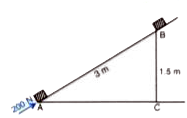
A block of mass 30 kg is pulled up a slope as shown in with constant speed by applying a force of 200 N parallel to the slope from the initial position A to the position B,
(a)Calculate :
(i)the work done by force in moving the block from A to B, and
(ii)The potential energy gained by the block Take, g=10 m `s^(-2)`
(b)Account for the difference in answers to parts (i) and (ii)

Text Solution

Verified by Experts

(a)Given :m=30 kg,F=200 N,AB=3 m and CB=1.5 m.
(i)Work done by the force in moving the block from A to B
=Force `xx` displacemet in the direction of force or `W=FxxAB`
`200 N xx3 m` =600 J
(ii)The potential energy gained by the block U=mgh where h=CB=1.5 m
`therefore U=30xx10xx1.5=450 J`
(b)Out of the work done 600 J ,only 450 J is the useful work raises the potential energy of the block and the remaining work =600 J-450 J=150 J is spent against the force of friction between the block and the slope which gets converted into heat energy
Promotional Banner

Topper's Solved these Questions

  • WORK ENERGY AND POWER

    ICSE|Exercise EXERCISE-2(A)|31 Videos
  • WORK ENERGY AND POWER

    ICSE|Exercise EXERCISE-2(A) (MULTIPLE CHOICE TYPE )|2 Videos
  • CALORIMETRY

    ICSE|Exercise EXERCISE-11(B) (NUMERICALS)|15 Videos

Similar Questions

Explore conceptually related problems

A block of 10kg is pulled at a constant speed on a rough horizontal plane by a force of 20N . Calculate the coefficient of friction ?

A block A, weighing 100 N is pulled up a slope of length 5 m by means of a constant force F (= 100 N) as illustrated in Fig. (a) What is the work done by the force F in moving the block A 5 m along the slope ? (b) What is the increase in potential energy of the block A? (c) Account for the difference in the work done by the force and the increase in potential energy of the block

A block of mass 2 kg is pulled along circular arc from position X to Y as shown in figure. The work done by the horizontal force is pulling the block from X to Y is

A force F is applied on a block of mass M . The block is displaced through a distance d in the direction of the force. What is the work done by the force on the block? Does the internal energy change because of this work?

A block of mass 4 kg is pulled along a smooth inclined plane of inclination 30^(@) with constant velocity 3 m/s as shown, power delivered by the force is

A block of mass m is taken from A to B under the action of a constant force F. Work done by this force is

A block of mass 2.0 kg kept at rest on an inclined plane of inclination 37^0 is pulledup the plane by applying a constant force of 20 N parallel to the incline. The force acts for one second. A. show that the work done by the applied force does not exceed 40 J. b. find the work work done by the applied force is 40 J. c. Find the kinetic energy of the block at the instant the force ceases to act. Take g=10 m/s^2 .

A block of mass 1 kg is pulled slowly along the curve path ACB by a tangential force as shown in figure. The magnitude of work done by the frictional force when the block moves from A to B is

A block of mass 2.0 kg is pushed down an inclined plane of inclination 37^0 with a force of 20N acting parallel to the incline. It is found that the block moves on the incline with an acceleration of 10 m/s^2 . If the block started from rest, find the work done a. by the applied force in the first second b. by the weight of the block in the first second and c. by the frictional force acting on the block in the first second. Take g=10 m/s^2 .

A block of mass 2.5 kg is pushed 2.20 m along a frictionless horizontal table by a constant force 16 N directed 45^@ above the horizontal. Determine the work done by. (a) the applied force, (b) the mormal force exerted by the table, (c) the force of gravity and (d) determine the total work done on the block.
