Home
Class 10
PHYSICS
The diagram in Figure shows the combinat...

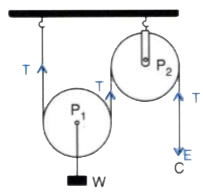
The diagram in Figure shows the combination of two pulleys `P_(1) and P_(2)` used to lift up a load W.
(a) State the kind of pulleys `P_(1) and P_(2)`.
(b) State the function of the pulley `P_(2)`.
(c) If the free end C of the string moves througha distance x, by what distance is the load W raised ?
(d) What effort E has to be applied at C to just raise the load W=20 kgf ? Neglect both the weight of the pulley `P_(1)` and friction.

Text Solution

Verified by Experts

(a) `P_(1)` is the movable pulley while `P_(2)` is the fixed pulley.
(b) The fixed pulley `P_(2)` is used to change the direction of effort to be applied, from upward direction to downward direction.
(c) If the free end C of the string moves through a distance x, the load W will rise by a distance x/2.
(d) Given W=20kgf, E=?
In equilibrium, W=2T and E=T
`therefore` Effort needed E=`(W)/(2)=(20kgf)/(2)=10kgf`.
Promotional Banner

Topper's Solved these Questions

  • MACHINES

    ICSE|Exercise EXERCISE-3(A)|40 Videos
  • MACHINES

    ICSE|Exercise EXERCISE-3(A) MULTIPLE CHOICE TYPE|5 Videos
  • HOUSEHOLD CIRCUITS

    ICSE|Exercise EXERCISE -9(B) (MULTIPLE CHOICE TYPE)|2 Videos
  • QUESTION PAPER 2022 TERM 1

    ICSE|Exercise MULTIPLE CHOICE QUESTIONS|40 Videos

Similar Questions

Explore conceptually related problems

From the diagram given below, answer the questions that follow: What effort has to be applied at C to just raise the load L=20 kgf? (Neglect the weight of pulley A and friction).

The diagram alongside shows a pulley arrangement : If the free end of the string moves through a distance x, find the distance by which the load is raised.

In a single movable pulley, if the effort moves by a distance x upwards, by what height is the load raised ?

In a single fixed pulley, if the effort moves by a distance x downwards, by what height is the load raised upwards ?

Blocks of mass M_(1) and M_(2) are connected by a cord which passes over the pulleys P_(1) and P_(2) as shown in the figure. If there is no friction, the acceleration of the block of mass M_(2) will be

Figure shows a block and tackle system of pulleys used to lift a load. (a) How many strands of tackle are supporting the load ? (b) Draw arrows to represent tension T in each strand. (c) What is the mechanical advantage of the system? (d) When load is pulled up by a distance 1 m, how far does the effort end move ? (e) How much effort is needed to lift a load of 100 N?

Although the effort in using a pulley is the same as the load, what is the benefit of using a pulley ?

The adjacent Figure shows a fixed pulley used by a boy to lift a load of 400 N through a vertical height of 5 m in 10 s. the effort applied by the boy on the other end of the rope is 480 N. (a) What is the velocity ratio of the pulley ? (b) What is the mechanical advantage ? (c) Calculate the efficiency of the pully. (d) Why is the efficiency of the pulley not 100% ? (e) What is the energy gained by the load in 10 s? (f) How much power was developed by the boy in raising the load ? (g) The boy has to apply an effort which is greater than the load he is lifting. what is the justification for using the pulley ?

The acceleration of the block B in fig. Assuming the surfaces and the pulley P_(1) and P_(2) are all smooth, is

The diagram alongside shows an arrangement of three pulleys A,B and C. the load is marked as L and the effort as E. (a) Name the pulleys A,B and C. (b) Mark in the diagram the directions of load (L), effort (E) and tension T_1 and T_(2) in the two strings. (c) How are the magnitudes of L and E related to the tension T_(1) ? (d) Calculate mechanical advantage and velocity ratio of the arrangement. (e) What assumptions have you made in parts (c) and (d) ?
