

Home
Class 10
PHYSICS
The diagram below shows a rod lifting a ...

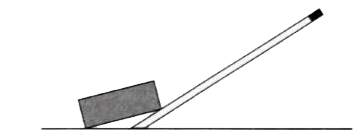
The diagram below shows a rod lifting a stone.
(a) Mark position of fulcrum F and draw arrows to show the directions of load L and effort E. (b) What class of lever is the rod ? (c) Give one more example of the same class of lever stated in part (b).
.

Promotional Banner

Topper's Solved these Questions

  • MACHINES

    ICSE|Exercise EXERCISE-3(A) MULTIPLE CHOICE TYPE|5 Videos
  • MACHINES

    ICSE|Exercise EXERCISE-3(A) NUMERICALS|12 Videos
  • MACHINES

    ICSE|Exercise EXERCISE-3(B) NUMERICALS|11 Videos
  • HOUSEHOLD CIRCUITS

    ICSE|Exercise EXERCISE -9(B) (MULTIPLE CHOICE TYPE)|2 Videos
  • QUESTION PAPER 2022 TERM 1

    ICSE|Exercise MULTIPLE CHOICE QUESTIONS|40 Videos

Similar Questions

Explore conceptually related problems

Figure, shows a lemon crushes, (a) In the diagram, mark the position of the fulcrum F and the line of action of load L and effort E. (b) Name the class of lever.

Draw a simple diagram ofa fire tongs and mark on it the fulcrum F and the points of application of load L and effort E. (a) Name the class of lever. (b) if load arm is 15 cm and effort arm is 5 cm. what is its mechanical adavantage?

The diagram below shows a claw hammer used to remove a nail : (i) To which class of lever does it belong? (ii) Give one more example of the same class of lever mentioned by you in (i) for which the mechanical advantage is greater than one.

Draw a diagram to show a block and tackle pulley system having a velocity ratio of 3 marking the direction of load (L), effort (E) and tension (T).

A lever of length 9 cm has its load arm 5 cm long and the effort arm is 9 cm long. (a) to which class does it belong ? (b) Draw a diagram of the lever showing the position of the fulcrum F and directions of both the load L and effort E. (c) what is the mechanical advantage and velocity ratio if the efficiency is 100%? (d) What will be the mechanical advantage and velocity ratio if the efficiency becomes 50%?

In Figure, draw a tackle to lift the load by applying the force in downward direction. (a) Mark in the diagram the direction of load L and effort E. (b) If the load is raised by 1 m, through what distance will the effot move ? (c) State the number of strands of tackle supporting the load. (d) What is the mechanical advantage of the system?

Figure below shoes the use of a lever. (a) State the principle of moments as applied to the above lever. (b) To which class of lever does it belong ? Give an example of this class of lever. (c) If FA=10 cm, AB=490 cm, calculate: (i) the mechanical advantage, and (ii) the minimum effort required to lift and load (=50N).

A block and tackle system has velocity ratio 3. draw a labelled diagram of the system indicating the points of application and the direction of load L and effort E. A man can exert a pull of 200 kgf. (a) What is the maximum load he can raise with this pulley system if its efficiency is 60% ? (b) if the effort end moves a distance 60 cm, what distance does the load move ?

The diagram alongside shows a pulley arrangement. (a) Name the pulleys A and B. (b) In the diagram, mark the direction of tension on each strand of string. (c) What is the purpose of the pulley B? (d) If the tension is T, deduce the relation between T and E (e) What is the velocity ratio of the arrangement ? (f) Assuming that the efficiency of the system is 100%, what is the mechanical advantage ?

The diagram below shows a pulley arrangemnet : (i) Copy the diagram and mark the direction of tension on each strand of the string. (ii) What is the velocity ratio of the arrangement ? (iii) If the tension acting on the string is T, then what is the relationship between T and effort E ? (iv) If the free end of the string moves through a distance x, find the distance by which the load is raised.

ICSE-MACHINES-EXERCISE-3(A)
  1. Both a pair of scissors and a pair of pliers belong to the same class ...

    Text Solution

    |

  2. Explain why scissors for cutting cloth may have blades longer than the...

    Text Solution

    |

  3. Figure, shows a uniform metre rule of weight W supported on a fulcrum ...

    Text Solution

    |

  4. Which typ eof lever has mechanical advantage always more than 1 ? Give...

    Text Solution

    |

  5. Draw a diagram of a lever which is always used as a force multiplier. ...

    Text Solution

    |

  6. Explain why mechanical advantage of a class II lever is always more th...

    Text Solution

    |

  7. Draw a labelled diagram of a class II lever. Give one example of such ...

    Text Solution

    |

  8. Figure, shows a lemon crushes, (a) In the diagram, mark the position...

    Text Solution

    |

  9. The diagram below shows a rod lifting a stone. (a) Mark position of ...

    Text Solution

    |

  10. State the kind of lever which always has mechanical advantage less tha...

    Text Solution

    |

  11. Explain why mechanical advantage of class III lever is always less tha...

    Text Solution

    |

  12. Class III levers have mechanical advantage less than 1. why are they t...

    Text Solution

    |

  13. Draw a labelled sketch of a class III lever. Give one example of this ...

    Text Solution

    |

  14. State the class of levers and the relative positions of load (L), effo...

    Text Solution

    |

  15. Draw diagrams to illustrate the positions of fulcrum, load and effort,...

    Text Solution

    |

  16. Classify the following into levers as class I, class II or class III: ...

    Text Solution

    |

  17. What type of lever is formed by a human body while (a) raising a load ...

    Text Solution

    |

  18. Indicate the positions of load L, effort E and fulcrum F in the forear...

    Text Solution

    |

  19. Give an example of each class of lever in a human body.

    Text Solution

    |

  20. Complete the following sentence: (a) Mechanical advantage=xxvelocity...

    Text Solution

    |