

Home
Class 10
PHYSICS
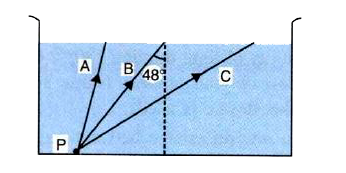
Figure shows a point source P inside a w...

Figure shows a point source P inside a water container. Three rays A,B and C starting from the source P are shown up to the water surface.
(a) show in the diagram the path of these rays after striking the water surface. The critical angle for water-air surface is `48^(@)`. (b) Name the phenomenon which the rays A, B and C exhibit.
.

Promotional Banner

Topper's Solved these Questions

  • REFRACTION OF LIGHT AT PLANE SURFACES

    ICSE|Exercise EXERCISE-4(D) MULTIPLE CHOICE TYPE|3 Videos
  • REFRACTION OF LIGHT AT PLANE SURFACES

    ICSE|Exercise EXERCISE-4(C) NUMERICALS|3 Videos
  • REFRACTION OF LIGHT

    ICSE|Exercise DIAGRAM BASED MCQ:|5 Videos
  • REFRACTION THROUGH A LENS

    ICSE|Exercise EXERCISE-5(D) (MULTIPLE CHOICE TYPE)|2 Videos

Similar Questions

Explore conceptually related problems

The diagram below shows a point source P inside a water container. Four rays A, B, C, D starting from the source P are shown up to the water surface. Show in the diagram the path of these rays after striking the water surface. The critical angle for water air surface is 48^(@) .

The diagram below shows a point source P inside a water container. Four rays A, B, C, D starting from the source P are shown up to the water surface. Name the phenomenon which the rays B and D exhibit.

A ray of light travels from water to air as shown in the diagram given below: Copy the diagram and complete the path of the ray. Given the critical angle for water is 48^(@) .

State the approximate value of the critical angle for (a) glass-air surface (b) water-air surface.

Figure shows the section of a semi-circular glass slab having its centre at O. three rays of light A,B and C of the same colour are incident on the slab and strike on the edge XY at the point O. the light ray B suffers refraction along OB'. (a) On the diagram, mark the critical angle by C. (b) The rays enter the slab undeviated. give reason. (c) Draw the path of rays A and C after they strike the edge XY. (d) Name the phenomenon which the rays A and C exhibit.

A ray of monochromatic light enters a liquid from air as shown in the diagram given below: Copy the diagram and show in the diagram the path of the ray of light after it strikes the mirror and reenters the medium of air.

Figure below shows a light ray of green colour incident on the prisms A,B and C. in each case, draw the path of the ray of light as it enters and emergest out of the prism. Mark the angle wherever necessary.

A container contains water up to a height of 20 cm and there is a point source at the centre of the bottom of the container. A rubber ring of radius r floats centrally on the water. The ceiling of the room is 2.0 m above the water surface. (a) Find the radius of the shadow of the ring formed on the ceiling if r = 15 cm. (b) Find the maximum value of r for which the shadow of the ring is formed on the ceiling. Refractive index of water =4/3.

Figure alongside shows two rays A and B travelling from water to air. If the critical angle for water-air surface is 48^(@) , complete the ray diagram showing the refracted for each. State conditions when the ray will suffer total internal reflection.

A point source is placed at a depth h below the surface of water (refractive index = mu ). The medium above the surface area of water is air from water.

ICSE-REFRACTION OF LIGHT AT PLANE SURFACES-EXERCISE-4(D)
  1. Fill in the blanks: Q: Critical angle is the angle of in denser medi...

    Text Solution

    |

  2. State whether the following statement is true or false ? If the angle ...

    Text Solution

    |

  3. The refractive index of air with respect to glass is expressed as ""(g...

    Text Solution

    |

  4. Figure alongside shows two rays A and B travelling from water to air. ...

    Text Solution

    |

  5. Figure shows a point source P inside a water container. Three rays A,B...

    Text Solution

    |

  6. In figure, PQ and PR are the two light rays emerging from an object P....

    Text Solution

    |

  7. The refractive index of glass is 1*5 from a point P inside a glass sla...

    Text Solution

    |

  8. A ray of light enters a glass slab ABCD as shown in figure and strikes...

    Text Solution

    |

  9. What is a total reflecting prism ? State three actions that it can pro...

    Text Solution

    |

  10. Show with the help of a diagram how a total reflecting prism can be us...

    Text Solution

    |

  11. A ray of light XY passes through a right angled isosceles prism as sho...

    Text Solution

    |

  12. Draw a diagram of a right angled isoscels prism which is used to make ...

    Text Solution

    |

  13. In figure, a ray of light PQ is incident normally on the hypotenuse of...

    Text Solution

    |

  14. In figure, a ray of light PQ is incident normally on the face AB of an...

    Text Solution

    |

  15. Copy the diagram given below and complete the path of the light ray ti...

    Text Solution

    |

  16. Draw a neat labelled ray diagram to show total internal reflection of ...

    Text Solution

    |

  17. (a) Figure shows two isosceles right angled prisms A and B and the lig...

    Text Solution

    |

  18. What device other than a plane mirror can be used to turn a ray of lig...

    Text Solution

    |

  19. Mention one difference between reflection of light from a plane mirror...

    Text Solution

    |

  20. State one advantage of using a total reflecting prism as a reflector i...

    Text Solution

    |