

Home
Class 12
PHYSICS
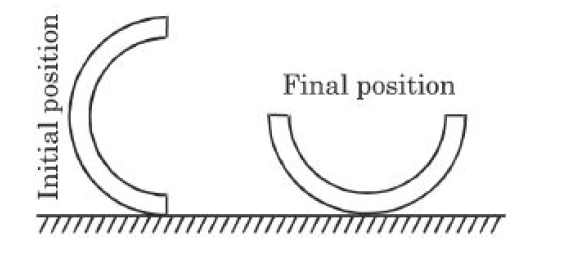
A half section of thin circular pipe of ...

A half section of thin circular pipe of mass m and radius 'r' is released from rest in the position shown. Pipe rolls without sliding. The change in potential energy of pipe after it has rolled through `90^@` :

Promotional Banner

Similar Questions

Explore conceptually related problems

A particle of mass m is rigidly attached at A to a ring of mass 3m and radius r . The system is released from rest and rolls without sliding. The angular acceleration of ring just after release is

A tangential force F acts at the top of a thin spherical shell of mass m and radius R . Find the acceleration of the shell if it rolls without slipping.

A ring of radius 4a is rigidly fixed in vertical position on a table. A small disc of mass m and radius a is released as shown in the fig. When the disc rolls down, without slipping, to the lowest point of the ring, then its speed will be

a solid sphere of mass 2 kg and radius 0.5 m is projected from point A on a rough inclined plane as shown in figure. If it rolls without sliding find time taken to reach again at A is?

A ring of mass M and radius R is at rest at the top of an incline as shown. The ring rolls down the plane without slipping. When the ring reaches bottom, its angular momentum about its centre of mass is:

A unifrom solid disk of radius R and mass M is free to rotate on a frictionless pivot through a point on its rim. If the disk is released from rest in the position shown in figure. The speed of the lowest point on the disk in the dashed position is. .

A solid cylinder of mass M and radius R rolls from rest down a plane inclined at an angle theta to the horizontal. The velocity of the centre of mass of the cylinder after it has rolled down a distance d is :

A semicircle disc of mass M and radius R is held on a rough horizontal surface as shown in figure. The centre of mass C of the disc is at a distance of (4R)/(3pi) from the point O . Now the disc is released from this position so that it starts rolling without slipping. Find (a) The angular acceleration of the disc at the moment it is relased from the given position. (b) The minimum co-efficient of fricition between the disc and ground so that it can roll without slipping.

A positive charge 'Q' is fixed at a point A negatively charged particle of mass ' 'm' and charge 'q' is revolving in a circular path of radius r_(1) ,with Q' as the centre.The change in potential energy to change the radius of the circular path from r_(1) to r_(2) in joule is