

Home
Class 6
PHYSICS
How can a non-luminous metal such as iro...


How can a non-luminous metal such as iron be made luminous?

Promotional Banner

Topper's Solved these Questions

  • LIGHT

    ICSE|Exercise Exercises (Section II) Long answer questions, |3 Videos
  • FORCE

    ICSE|Exercise Picture Based Questions |2 Videos
  • MAGNETISM

    ICSE|Exercise Picture Based Questions |12 Videos

Similar Questions

Explore conceptually related problems

A luminous object

A circular area of radius 1.0 cm is placed at a distance of 2.0 m from a poit source.Teh source emits light uniformluy in al directions. The line joining the sorce to the dcentre of the area is normal to the area. It ils found that 2.0xx1^-3 lumen of luminous flux is incident on the area. Calculate the total luminous flux emitted by the soure and teh luminous intensity of the source along the axis of the area.

How can a substance be made amorphous?

Dimensions of luminous flux are

A source emits 12.0 J of lightof wavelength 620 nm and 8.0 J of light of wavelength 580 nm per second. The relative luminosilty at 620 is 25% and that at 580 nm is 80%. Find a the total radiant flux, b. the total luminous flux and c. and luminous efficiency.

Mention two uses of the following metals and non-metals : (a) Iron (b) Aluminium (c) Gold (d) Oxygen (e) Iodine

The metallic ions (the cations) can be identify by performing flame test which is describe below. "Make a paste of the given salt in concentrated hydrochloric acid. Load the paste on a clean platinum wire and introduce it in a non-luminous bunsen burner flame. Note the colour of the flame imparted by the flame. Tabulate your answer in the formate given below. The salt x imparts golden yellow flame. The salt y imparts lilac flame and the salt z imparts bright red flame.

Why do alkali metals show characteristic colours in a non luminous flame?

Cell organelle that divides intracellular space of a cell into two compartment luminal space and extra luminal space

ICSE-LIGHT-Picture Based Questions
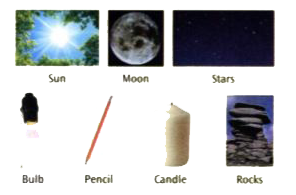
  1. Categorize the objects shown above as luminous and non-luminous object...

    Text Solution

    |

  2. How can a non-luminous metal such as iron be made luminous?

    Text Solution

    |

  3. What is bioluminescence?

    Text Solution

    |

  4. What are the substances that allow most of the light to pass through t...

    Text Solution

    |

  5. What are the substances that do not allow light to pass through them c...

    Text Solution

    |

  6. Transparent object and translucent object

    Text Solution

    |

  7. The moon does not have light of its own. How are we then able to see t...

    Text Solution

    |

  8. What happens if an opaque object is placed in the path of light as sho...

    Text Solution

    |

  9. How does the nature of a shadow depend on the light source?

    Text Solution

    |

  10. How much light does the umbra region of a shadow receive from the sour...

    Text Solution

    |

  11. What is the region of a shadow that receives some light from the sourc...

    Text Solution

    |

  12. Label the figure.

    Text Solution

    |

  13. What are the characteristics of an image formed by a pinhole camera?

    Text Solution

    |

  14. What determines the size of a pinhole camera image?

    Text Solution

    |

  15. Name the type of eclipses shown in the Figures 1 and 2.

    Text Solution

    |

  16. Why do these objects form shadows?

    Text Solution

    |

  17. When does a lunar eclipse take place?

    Text Solution

    |

  18. In which region of the Earth's shadow is the moon, when a total lunar ...

    Text Solution

    |

  19. Which celestial object is responsible for blocking the light of the su...

    Text Solution

    |

  20. What is the position of an observer on the Earth who sees a partial so...

    Text Solution

    |