

Home
Class 8
PHYSICS
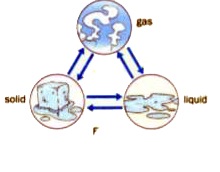
Figure A shows the change of states of m...

Figure A shows the change of states of matter. In it, add the following words: deposition, condensation, melting, sublimation, freezing, and evaporation.

Promotional Banner

Similar Questions

Explore conceptually related problems

Write the sequence of change in state of matter when ice melts

State which of the following terms connected with change of state of matter i.e. - a] Melting b] Vaporisation c] Condensation d] Freezing - pertain to - (i] Conversion of a liquid into a vapour or gas [ii] Conversion of a liquid into a solid. [iii] Conversion of a solid into a liquid on heating.

Phase transitions are ubiquitous in nature. We are all familiar with the different phase of water (vapour, liquid and ice) and with the change from one to another, the change of phase are called phase transitions. There are six ways a substance can change between these three phase, melting, freezing, evaporating, condensing sublimation and decomposition. At 1 atm pressure vaporisation of 1 mole of water from liquid (75^(@)C) to vapour (120^(@)C) . C_(v)(H_(2)O,l)=75 J "mole"^(-1)K^(-1), C_(p)(H_(2)O,g)=33.3J"mole"^(-1)K^(_1) Delta H_(vap) at 100^(@)C=40.7KJ//"mole" Calculate change in internal energy when Water liquid at 75^(@)C to 100^(@)C ?

Phase transitions are ubiquitous in nature. We are all familiar with the different phase of water (vapour, liquid and ice) and with the change from one to another, the change of phase are called phase transitions. There are six ways a substance can change between these three phase, melting, freezing, evaporating, condensing sublimation and decomposition. At 1 atm pressure vaporisation of 1 mole of water from liquid (75^(@)C) to vapour (120^(@)C) . C_(v)(H_(2)O,l)=75 J "mole"^(-1)K^(-1), C_(p)(H_(2)O,g)=33.3J"mole"^(-1)K^(_1) Delta H_(vap) at 100^(@)C=40.7KJ//"mole" Calculate change in internal energy when Water vapour at 100^(@)C to 120^(@)C ?

Phase transitions are ubiquitous in nature. We are all familiar with the different phase of water (vapour, liquid and ice) and with the change from one to another, the change of phase are called phase transitions. There are six ways a substance can change between these three phase, melting, freezing, evaporating, condensing sublimation and decomposition. At 1 atm pressure vaporisation of 1 mole of water from liquid (75^(@)C) to vapour (120^(@)C) . C_(v)(H_(2)O,l)=75 J "mole"^(-1)K^(-1), C_(p)(H_(2)O,g)=33.3J"mole"^(-1)K^(_1) Delta H_(vap) at 100^(@)C=40.7KJ//"mole" Calculate change in internal energy when Water liquid at 100^(@)C to vapour at 100^(@)C ?

What is inter-conversion of matter. Give the meaning of the terms involved in inter-conversion of matter - a] Melting b] Vaporisation c) Liquefaction or condensation d] Solidification or freezing e] Sublimation

Look at the change of state diagram from gas to solid given here carefully, and answer the following questions. a. During freezing, certain amount of heat is given out without any change in temperature. Which part of the graph shows this change? b. During condensation, certain amount of heat is given out without any change in temperature. Which part of the graph shows this change? c. Which point on the graph corresponds to İ. condensation point? ii. freezing point? d. What do ab and cd on the graph represent?

The figure shows two paths for the change of state of a gas from A to B. The ratio of molar heat capacities in path 1 and path 2 is

The figure shows two paths for the change of state of a gas from A to B. The ratio of molar heat capacities in path 1 and path 2 is

State whether the following are physical or chemical changes. Melting of wax