

Home
Class 8
PHYSICS
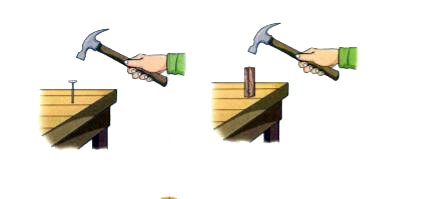
Compare the actions in Figure C and expl...

Compare the actions in Figure C and explain what happens in both cases and why?

Promotional Banner

Topper's Solved these Questions

  • FORCE AND PRESSURE

    ICSE|Exercise Exercises (Section II) Numerical questions |10 Videos
  • ENERGY

    ICSE|Exercise THEME ASSIGNMENT |4 Videos
  • HEAT TRANSFER

    ICSE|Exercise Picture Study |2 Videos

Similar Questions

Explore conceptually related problems

Explain what happens when boric acid is heated.

In figure (a), (b) and (c), which appears more accurate and why?

Give balanced equations and explain what happens when glycerol reacts with conc. H_(2)SO_(4) .

What is gout and why does it happen?

A container A is having some fluid of density theta_(0) . If is connected with a U tube manometer shown in figure. Find the pressure of the container in both the cases given in figure.

Figure a) shows a spring of force constant k clamped rigidly at once end and a mass m attached to its free end. A force F applied at the free end stretches the spring. Figure b) shows the same spring with both ends free and attached to a mass m at either end. Each end of the spring in figure is stretched by the same force F. (a) What is the maximum extension of the spring in the two cases ? (b) If the mass in figure and the two masses in figure are released free, what is the period of oscillation in each case?

Figure a) shows a spring of force constant k clamped rigidly at once end and a mass m attached to its free end. A force F applied at the free end stretches the spring. Figure b) shows the same spring with both ends free and attached to a mass m at either end. Each end of the spring in figure is stretched by the same force F. (a) What is the maximum extension of the spring in the two cases ? (b) If the mass in figure and the two masses in figure are released free, what is the period of oscillation in each case?

(a) Why is nutrition necessary for the human body? (b) what causes movement of food inside the alimentary canal? (c) why is small intestine in herbivores longer than in carnivores ? (d) what will happen if mucus is not secreted by the gastric glands ?

Describe hybridisation in the case of PCl_(5) and SF_(6) The axial bonds are longer as compared to equatorial bonds in PCl_(5) whereas in SF_(6) both axial bonds and equatorial bonds and have the same bond length. Explain.

Hydrogen is evolved when dilute HCl reacts with magnesium, but nothing happens in the case of mercury and silver. Explain.