

Home
Class 8
PHYSICS
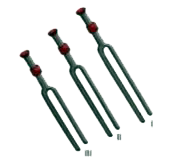
Look at the three tuning forks given in ...

Look at the three tuning forks given in Figure B. The longest is I, the middle one is II, and the shortest is III. Looking at the length find out which one has a higher pitch than the others.

Promotional Banner

Topper's Solved these Questions

  • SOUND

    ICSE|Exercise Exercises (Section II) Long answer questions|6 Videos
  • PHYSICAL QUANTITIES AND MEASUREMENT

    ICSE|Exercise Picture Study|3 Videos
  • WORK AND ENERGY

    ICSE|Exercise Picture Study |3 Videos

Similar Questions

Explore conceptually related problems

Use the information given in the adjoining figure to find : (i) the length of AC. (ii) the are a of DeltaABC . (iii) the length of BD, correct to one decimal place.

The boundary of the shaded region in the given figure consists of three semicircular areas, the smaller ones being equal. If the diameter of the larger one is 14 cm, calculate (i) the length of the boundary (ii) the area of the shaded region

From Figure C, find out which wave has a. low pitch and high volume b. high pitch and low volume c. high pitch and high volume d. low pitch and low volume.

A tuning fork A is in resonance with an air column 32 cm long and closed at one end . When the length of this column is increased by 1 cm ,it is in resonance with another fork B . When A and B are sounded together , they produce 40 "beats in" 5 s . Find their frequencies .

In each figure alongside, a letter of the alphabet is shown along with a vertical line. Take the mirror image of the letter in the given line. Find which letters look the same after reflection (i.e. which letters look the same in the image) and which do not. Can you guess why

A rectangular lawn is 30 m by 20 m. It has two roads each 2 m wide running in the middle of it one parallel to the length and the other parallel to the breadth. Find the area of the roads.

Given three identical boxes I, II and III, each containing two coins. In box I both coins are gold coins, in box II both are silver coins and in box III there is one gold and one silver coin. A person chooses a box at random and takes out a coin. If the first coin is gold, what is the probability that the other coin in the box is gold.

Given three identical boxes I, II and III each containing two coins. In box I, both coins are gold coins, in box II, both are silver coins and in box III, there is one gold and one silver coin. A person chooses a box at random and takes out a coin. If the coin is of gold, what is the probability that the other coin in the box is also of gold?

Given three identical boxes I, II and III, each containing two coins. In ox I both coins are gold coins, in box II both are silver coins and in box III there is one gold and one silver coin. A person chooses a box at random and takes out a coin. If the coin is of gold, what is the probability that the other coin in the box is also of gold?

Looking at the two tables below, figure out which one depicts (a) uniform velocity (b) non-uniform velocity