

Home
Class 12
CHEMISTRY
The sums of first and second ionisation ...

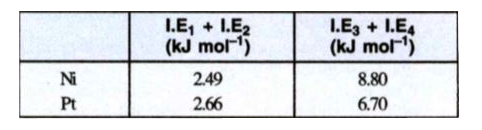
The sums of first and second ionisation energies and those of third and fourth ionisation energies of nickel and platinum are given below:

Taking these values into account write
(i) The most common oxidation state for Ni and Pt and its reason.
(ii) The name of the metal (Ni or Pt) which can form compounds in +4 oxidation state more easily and why?

Promotional Banner

Topper's Solved these Questions

  • d- AND- f- BLOCK ELEMENTS

    ICSE|Exercise EXERCISE (PART-II) (DESCRIPTIVE QUESTIONS)(LONG ANSWER QUESTIONS)|51 Videos
  • d- AND- f- BLOCK ELEMENTS

    ICSE|Exercise ISC EXAMINATION QUESTIONS (PART-II)(DESCRIPTIVE QUESTIONS)|15 Videos
  • d- AND- f- BLOCK ELEMENTS

    ICSE|Exercise EXERCISE (PART-II) (DESCRIPTIVE QUESTIONS)(VERY SHORT ANSWER QUESTIONS)|91 Videos
  • COORDINATION COMPOUNDS

    ICSE|Exercise ISC EXAMINATION QUESTION (PART- II DESCRIPTIVE QUESTIONS)|39 Videos
  • DISTINCTION BETWEEN PAIRS OF COMPOUNDS

    ICSE|Exercise QUESTIONS |155 Videos

Similar Questions

Explore conceptually related problems

The elements of 3d transition series are given as : Sc Ti V Cr Mn Fe Co Ni Cu Zn Answer the following : (i) Write the element which shows maximum number of oxidation states. Give reason. (ii) Which elements has the highest m.p? (iii) Which element is a strong oxidizing agent in +3 oxidation state and why ?

Ni (II) compounds are thermodynamically more stable than Pt(II) compounds but the order is reverse in case of + 4 oxidation states. Why?

The transition element ( with few exceptions ) show a large number of oxidation states . The various oxidation states are related to the electronic configuration of their atoms. The variable oxidation states of a transition metal is due to the involvement of (n-1)d and outer ns electrons . For the first five elements of 3d transition series , the minimum oxidation state is equal to the number of electrons in 4s shell and the maximum oxidation state is equal to the sum of 4s and 3d electrons. The relative stability of various oxidation states of a given element can be explained on the basis of stability of d^(0),d^(5) and d^(10) configuration . In which of the following pairs , the first species is more stable than second one

Oxidation number is the charge which an atom of an element has in its ion or appears to have when present in the combined state. It is also called oxidation state. Oxidation number of any atom in the elementary state is zero. Oxidation number of a monoatomic ion is equal to the charge on it. In compounds of metals with non metals, metals have positive oxidation number while non metals have negative oxidation numbers. In compounds of two difference elements, the more electronegative element has negative oxidation number whereas the other has positive oxidation number. In complex ions, the sum of the oxidation number of all the atoms is equal to the charge on the ion. If a compound contains two or more atoms of the same element, they may have same or different oxidation states according as their chemical bonding is same or different. The oxidation state of the most electronegative element in the products of the reaction between BaO_(2) and H_(2)SO_(4) are

Transition metals combine with halogens at high temperature to form compounds called halides. On account of high activation energy , the reactions require high temperature to start, but once the the reaction is started , the heat of reaction is sufficient to maintain the continuity . Metals in higher oxidation state form flourides as it is the most electronegative element . Flourides are ionic in nature . The chlorides , bromides and iodides have ionic as well as covalent character . Halides of metals is higher oxidation states are relatively unstable and hydrolysed very easily . DeltaH_(f) is negative for

Transition metals combine with halogens at high temperature to form compounds called halides. On account of high activation energy , the reactions require high temperature to start, but once the the reaction is started , the heat of reaction is sufficient to maintain the continuity . Metals in higher oxidation state form flourides as it is the most electronegative element . Flourides are ionic in nature . The chlorides , bromides and iodides have ionic as well as covalent character . Halides of metals is higher oxidation states are relatively unstable and hydrolysed very easily . Aqueous solution of which compound will have pH lt 7 ?

The IUPAC definition of a transition element is that it is an element that has an incomplete d-subshell in either the neutral atom or its ion. Thus the group 12 elements are member of the d-block but are not transition elements. Chemically solft members of the d-block occurs as sulphide minerals and are partially oxidised to obtain the metal, the more electropositive 'hard' metals occurs as oxides and are extracted by reduction. Opposite to p-block elements, the higher oxidation states are favoured by the heavier elements of d-block Metals on the right of the d-block tend to exist in low oxidation states and form complexes with the ligands. Square-planar complexes are common for the platinum metals and gold in oxidation states that yield d^8 electronic configuration, which include RH(I),Ir(I),Pd(II),Pt(II) and Au(III). The most distinctive features/properties of transition metal complex is their wide range of colours.The crystal field theory attributes the colour of the coordination compounds to d-d transition of the electron.It is important to note that (a) in absence of ligand, crystal field spilling does not occur and hence the substances is colourless, (b) the type of ligand also influences the colour of the complexes. Which of the following has dsp^2 hybridisation and is diamagnetic in nature ? (i) Na_4[Cr(CO)_4] , (ii) [Ni(DMGH)_2] , (iii) [PtHBr(PEt_3)_2] (iv) [As(SCN)_4]^(3-) , (v) [AuBr_4]^(-)

How would you account for the following : (i) The metallic radii of the third (5d) series of transition metals are virtually the same as those of the corresponding group members of the seconds (4d) series. (ii) There is a greater range of oxidation states among the actinoids than among the lanthanoids.

Select from the given below (A to F), the one substance in each case which matches the descriptions given in parts (i) to (vi). Copy and complete the given grid with your answers as shown for part (i). (A) Ammonia (B) Copper oxide (C) Copper sulphate (D) Hydrogen chloride (E) Hydrogen sulphide (F) Lead bromide (i) Although this compound is not a metal hydroxide, its aqueous solution is alkaline in nature. (ii) A solution of this compound is used as the electrolyte when copper is purified. (iii) When this compound is electrolysed in the molten state, lead is obtained at the cathode. (iv) This compound can be oxidized to chlorine. (v) This compound smells of rotten eggs. (vi) This compound can be reduced to copper when heated with coke.

Stabilities of alkanes can be compared by converting these compounds to a common product and comparing the amount of the heat given off. One possiblitiy would be to measure the heat of combustion from converting alkenes to xo_(2) and H_(2)O . The heats of combustion are of large values and measuring small difference in these large numbers is difficult. Alkene of the lowest heat of combustion among isomeric alkenes is of the lowest energy and is most stable. Th stability of alkenes is often compared by meansuring the ehat of hydrogenation 9 heat given off, Delta H_(h)^(@) during catalytic hydrogenation. The heat of hydrogenation is in smal number, which provides more accurate energy difference. For a compound containing more than one double bond, Delta_(h)^(@) is the sum of heat of hydrogenation of individual double bonds. For non - conjugated diens, this additive relatioship is found to hold. For conjugated dienes, however, the measured value is slightly lower than expected. Cumulated dienes, which are even less stable than non - conjugated dienes. The more stable is the alkene, lower is the heat of combustion and heat of hydrogenation. More highly substituted double bonds are usually more stable. In case of cyclokanes, compounds having higher angle strin are less stable. Arrange the following compounds according to their increasing heat of combustion. I. 1- Butene II. cis -2- Butene III. trans -2- Butene IV. 2- Methyl propene

ICSE-d- AND- f- BLOCK ELEMENTS-EXERCISE (PART-II) (DESCRIPTIVE QUESTIONS)(SHORT ANSWER QUESTIONS)
  1. What are different oxidation states exhibit by lanthanoids?

    Text Solution

    |

  2. Explain the following terms : (a) Chemistry of all Lanthanoids is so...

    Text Solution

    |

  3. What is the electronic difference between lanthanoids and actinoids? W...

    Text Solution

    |

  4. Name the elements with atomic number 58 and 59 and write their electro...

    Text Solution

    |

  5. What are inner-transition elements? Write their general electronic con...

    Text Solution

    |

  6. Define lanthanoids. Give three differences between lanthanoids and act...

    Text Solution

    |

  7. What happens when : (i) Acidified K2Cr2O7 reacts with Kl. (ii) K2...

    Text Solution

    |

  8. The sums of first and second ionisation energies and those of third an...

    Text Solution

    |

  9. Of the ions Ag^(+),Co^(2+) and Ti^(4+) ,which ones will be coloured in...

    Text Solution

    |

  10. Among ionic species, Sc^(3+), Ce^(4+) and Eu^(2+), which one is a goo...

    Text Solution

    |

  11. of the ions Co^(2+), Sc^(3+) and Cr^(3+) which one will give coloured ...

    Text Solution

    |

  12. A transition element forms alloys with other transition metals easily....

    Text Solution

    |

  13. (i) Give the formula which expresses the general electronic configurat...

    Text Solution

    |

  14. [Ti(H2O)6]^(3+) is coloured while [Sc(H2O)6]^(3+) is colourless . Expl...

    Text Solution

    |

  15. Represent the reaction of acidified K2Cr2O7 with: (i) KI solution (...

    Text Solution

    |

  16. Assertion : KMNO4 acts as an oxidising agent in acidic, basic or neutr...

    Text Solution

    |

  17. How is that in alkaline solution we have chromate and in acidic soluti...

    Text Solution

    |

  18. Decribe, how potassium dichromate is prepared from chromite. Write the...

    Text Solution

    |

  19. Describe how potassium permanganate is prepared from pyrolusite. Write...

    Text Solution

    |

  20. What is lanthanoid contraction? What are the consequences of lanthanoi...

    Text Solution

    |