

Home
Class 12
PHYSICS
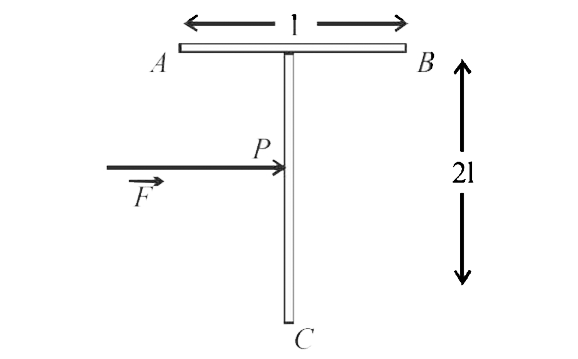
A 'T' shaped object with dimensions show...

A 'T' shaped object with dimensions shown in the figure, is lying on a smooth floor. A force `'vecF'` is applied at the point P parallel to AB, such that the object has only the translational motion without rotation. Find the location of P with respect C.

Promotional Banner

Similar Questions

Explore conceptually related problems

A 'T' shaped object with dimensions shown in the figure, is lying on a smooth floor. A froce 'vacF' is applied at the point P parallel to AB, such that the object has only the translational motion without rotaion. Find the location of P with respect C.

An inverted T -shaped object is placed on a horizontal floor as shown in Fig. A force F is applied on the system as shown in Fig. The value of x so that the system performs pure translational motion is

A rectangular block of mass M and height a is resting on a smooth level surface. A force F is applied to one corner as shown in Fig. At what point should a parallel force 3F be applied in order that the block shall undergo pure translational motion? Assume normal contact force a between the block and surface passes through the centre of gravity of the block.

Portion AB of the wedge shown in figure is rough and BC is smooth. A solid cylinder rolld without slipping from A to B . Find the ratio of translational kinetic energy to rotationa linetic energy, when the cylinder reaches point C . .

In the arrangements shown in the figure there is friction only between the light string and the sharp spike at the point P. when the blocks are in motion, the tensions in the vertical and horizontal sections of the string are 4N and 3N respectively. The co-efficient of friction between the string and the spike is equal to

A point is placed in front of thick plane mirror as shown in figure. Find the location of final image w.r.t. object.

Consider a cylinder of mass M and radius R lying on a rough horizontal plane. It has a plank lying on its top as shown in the figure. A force F is applied on the plank such that the plank moves and causes the cylinder to roll. The plank always remains horizontal. There is no slipping at any point to contact. (a) what are the directions of the fricition forces acting at A and B on the plank and the cylinder ? (b) Calculate the acceleration of the cylinder. (c ) Find the value of frictional force at A & B .

The momentum p of an object varies with time (t) as shown in figure. The corresponding force (F)- time (t) graph is -