

Home
Class 11
PHYSICS
Two blocks A and B are separated by some...

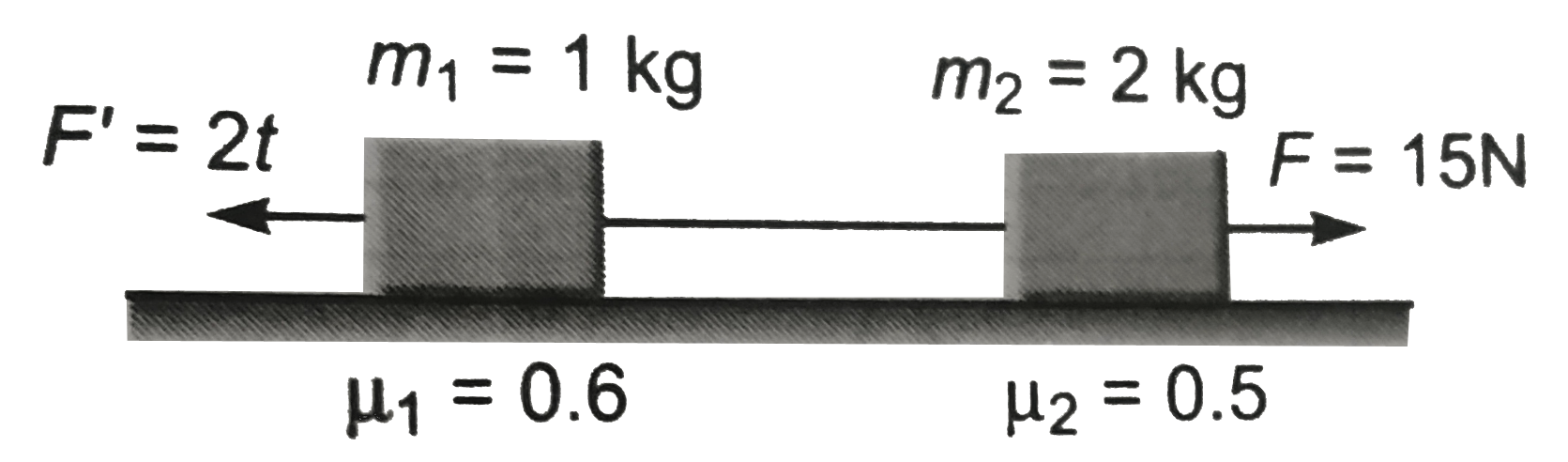
Two blocks `A` and `B` are separated by some distance and tied by a string as shown in the figure . The force of friction in both the blocks at `t = 2 s` is

Promotional Banner

Similar Questions

Explore conceptually related problems

Two block A and B are separted by some distance and tied by a string as shown in the figure . The force of friction in both the block at t = 2 s is

As shown in the figure , the friction force acting on the block is

The friction force acting on the block at time t = 4 s will be

Find the force of friction acting between both the blocks shown in the figure.

A blocked of mass m is attached with two strings as shown in figure .Draw the free body diagram of the block.

Two blocks A and B are lying on the table as shown in the figure. The coefficient of friciton between block A and block B is mu . The coefficient of friction between block B and ground also mu . An external force F is applied in the direction shown. The maximum value of the force F that can be applied without moving the blocks.

Two blocks A and B are connected by as string as shown in figure. Friction coefficient of the incline plane and block is 0.5 . The mass of the block A is 5 kg . If minimum & maximum values of masses of the block B for which the block remains in equilibrium are m_(1) & m_(2) then find value of (m_(2) - m_(1)) .

Two blocks of same mass are kept on a horizontal rough surface as shown in the figure. Coefficient of friction between the blocks and surface is 0.1. A force of 16 N is applied on one block as shown in figure. Find the tension (in newton) in the string.

If the mass of block is 1 kg and a force of 10 / sqrt3 N is applied horizontally on the block as shown in the figure . The frictional force acting on the block is :

Two blocks A and b are placed on a table and joined by a string . The limitaing frition for both blocks is F .The tension in the string is T. the forces of friction acting on the blocks are F_(A) and F_(b) An external horizontal force P=3F//2 acts on A, directed aways from B.