Home
Class 11
CHEMISTRY
The first (Delta(i), H(1)) and the secon...

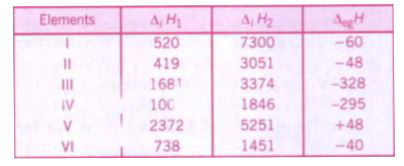
The first (`Delta_(i), H_(1)`) and the second (`Delta, H_(2)`) ionisation enthalpies (in kJ mo`l^(- 1)` ) and the `(Delta_(eg)H`) electron gain enthalpy (in kJ mo`l^(-1)` ) of a few elements are given below :

Which of the above elements is likely to be :
the least reactive element?

Text Solution

Verified by Experts

Element II. Since it has the least first ionisation enthalpy and a low value for electron gain enthalpy, it is expected to be the most reactive metal. It should be an alkali metal.
Promotional Banner

Topper's Solved these Questions

  • CLASSIFICATION OF ELEMENTS AND PERIODICITY IN PROPERTIES

    ICSE|Exercise ASSERTION-REASON TPE QUESTIONS|6 Videos
  • CHEMICAL THERMODYNAMICS

    ICSE|Exercise NCERT TEXT-BOOK. EXERCISES|22 Videos
  • ENVIRONMENTAL CHEMISTRY

    ICSE|Exercise NCERT TEXT-BOOK EXERCISE|20 Videos

Similar Questions

Explore conceptually related problems

The first ( Delta_(i), H_(1) ) and the second ( Delta, H_(2) ) ionisation enthalpies (in kJ mo l^(- 1) ) and the (Delta_(eg)H ) electron gain enthalpy (in kJ mo l^(-1) ) of a few elements are given below : Which of the above elements is likely to be : a reactive metal

The first (DeltaH_(1)) and second (DeltaH_(2)) ionisation enthalpies (in kJ mol^(-1)) and the (DeltaH_(eg)) electron gain enthalpy (in kJ mol^(-1)) of a elements are given below: Based on the above information match the following columns.

The first ( IE_(1) ) and the second (IE_(2)) ionisation energies (kJ mol^(-1) ) of a few elements are given below : Which of the above elements is likely to be a noble gas?

The first ( IE_(1) ) and the second (IE_(2)) ionisation energies (kJ mol^(-1) ) of a few elements are given below : Which of the above elements is likely to be a reactive non-metal?

The first ( IE_(1) ) and the second (IE_(2)) ionisation energies (kJ mol^(-1) ) of a few elements are given below : Which of the above elements is likely to be a reactive metal?

The first (Delta_(i)H_(1)) and second (Delta_(i)H_(2)) ionisation enthalpies ("in" kJ mol^(-1)) and the (Delta_(eg)H^(ө)) electron gain enthalpy ("in" kJ mol^(-1)) of a few elements are given below: {:("Elements",(Delta_(i)H_(1)),(Delta_(i)H_(2)),Delta_(eg)H^(ө)),(I,520,7300,-60),(II,419,3051,-48),(III,1681,3374,-328),(IV,1008,1846,-295),(V,2372,5251,+48),(VI,738,1451,-40):} Which of the above elements is likely to be a. the least reactive element. b. the most reactive metal. c. the most reactive non-metal. d. the least reactive non-metal. e. the metal which can form a stable binary halide of the formula MX_2 (X=halogen). f. the metal which can form a predominantly stable covalent halide of the formula MX(X=halogen).

First and second ionisation enthalpies(in KJ/mol) of few elements are given below: Which of the above elements will form halides with formula MX_(2) ?

The first and second ionization enthalpies and electron gain enthalpy of some elements are as given below: Which of the elements given above is the least reactive?

The first and second ionization enthalpies and electron gain enthalpy of some elements are as given below: Which of these elements is the most reactive metal?

The first and second ionization enthalpies and electron gain enthalpy of some elements are as given below: Which of these elements is the least reactive non-metal?

ICSE-CLASSIFICATION OF ELEMENTS AND PERIODICITY IN PROPERTIES-NCERT TEXT-BOOK. EXERCISE (With Hints and Solutions)
  1. Assign the position of the element having outer electronic configurati...

    Text Solution

    |

  2. The first (Delta(i), H(1)) and the second (Delta, H(2)) ionisation ent...

    Text Solution

    |

  3. The first (Delta(i), H(1)) and the second (Delta, H(2)) ionisation ent...

    Text Solution

    |

  4. The first (Delta(i), H(1)) and the second (Delta, H(2)) ionisation ent...

    Text Solution

    |

  5. The first (Delta(i), H(1)) and the second (Delta, H(2)) ionisation ent...

    Text Solution

    |

  6. Calculate the work done when 1.0 mole water at 373K vaporizes against ...

    Text Solution

    |

  7. The first (Delta(i), H(1)) and the second (Delta, H(2)) ionisation ent...

    Text Solution

    |

  8. Predict the formulae of the stable binary compounds that would be form...

    Text Solution

    |

  9. Predict the formulae of the stable binary compounds that would be form...

    Text Solution

    |

  10. Predict the formulae of the stable binary compounds that would be form...

    Text Solution

    |

  11. Predict the formulae of the stable binary compounds that would be form...

    Text Solution

    |

  12. Predict the formulae of the stable binary compounds that would be form...

    Text Solution

    |

  13. Predict the formulae of the stable binary compounds that would be form...

    Text Solution

    |

  14. In the modern periodic table, the period indicates the value of :

    Text Solution

    |

  15. Which of the following statements related to the modern periodic table...

    Text Solution

    |

  16. Anything that influences the valence electrons will affect the chemist...

    Text Solution

    |

  17. The size of isoelectronic species - F^(-), Ne and Na^(+) is affected b...

    Text Solution

    |

  18. Which one of the following statements is incorrect in relation to ioni...

    Text Solution

    |

  19. Considering the elements B, Al, Mg, and K, the correct order of their ...

    Text Solution

    |

  20. Considering the elements B, C, N, F, and Si, the correct order of thei...

    Text Solution

    |
