Home
Class 11
CHEMISTRY
The first (Delta(i), H(1)) and the secon...

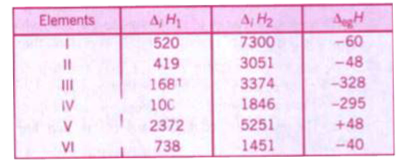
The first (`Delta_(i), H_(1)`) and the second (`Delta, H_(2)`) ionisation enthalpies (in kJ mo`l^(- 1)` ) and the `(Delta_(eg)H`) electron gain enthalpy (in kJ mo`l^(-1)` ) of a few elements are given below :

Which of the above elements is likely to be :
a reactive metal

Text Solution

Verified by Experts

Element I. Since it has low first ionisation enthalpy and a very high value for second ionisation enthalpy, it is expected to be an alkali metal. It should be Li (lithium) as it forms predominantly stable covalent halides of the formula MX.
Promotional Banner

Topper's Solved these Questions

  • CLASSIFICATION OF ELEMENTS AND PERIODICITY IN PROPERTIES

    ICSE|Exercise ASSERTION-REASON TPE QUESTIONS|6 Videos
  • CHEMICAL THERMODYNAMICS

    ICSE|Exercise NCERT TEXT-BOOK. EXERCISES|22 Videos
  • ENVIRONMENTAL CHEMISTRY

    ICSE|Exercise NCERT TEXT-BOOK EXERCISE|20 Videos

Similar Questions

Explore conceptually related problems

The first ( Delta_(i), H_(1) ) and the second ( Delta, H_(2) ) ionisation enthalpies (in kJ mo l^(- 1) ) and the (Delta_(eg)H ) electron gain enthalpy (in kJ mo l^(-1) ) of a few elements are given below : Which of the above elements is likely to be : the least reactive element?

The first (DeltaH_(1)) and second (DeltaH_(2)) ionisation enthalpies (in kJ mol^(-1)) and the (DeltaH_(eg)) electron gain enthalpy (in kJ mol^(-1)) of a elements are given below: Based on the above information match the following columns.

The first ( IE_(1) ) and the second (IE_(2)) ionisation energies (kJ mol^(-1) ) of a few elements are given below : Which of the above elements is likely to be a reactive metal?

The first ( IE_(1) ) and the second (IE_(2)) ionisation energies (kJ mol^(-1) ) of a few elements are given below : Which of the above elements is likely to be a reactive non-metal?

The first ( IE_(1) ) and the second (IE_(2)) ionisation energies (kJ mol^(-1) ) of a few elements are given below : Which of the above elements is likely to be a noble gas?

The first (Delta_(i)H_(1)) and second (Delta_(i)H_(2)) ionisation enthalpies ("in" kJ mol^(-1)) and the (Delta_(eg)H^(ө)) electron gain enthalpy ("in" kJ mol^(-1)) of a few elements are given below: {:("Elements",(Delta_(i)H_(1)),(Delta_(i)H_(2)),Delta_(eg)H^(ө)),(I,520,7300,-60),(II,419,3051,-48),(III,1681,3374,-328),(IV,1008,1846,-295),(V,2372,5251,+48),(VI,738,1451,-40):} Which of the above elements is likely to be a. the least reactive element. b. the most reactive metal. c. the most reactive non-metal. d. the least reactive non-metal. e. the metal which can form a stable binary halide of the formula MX_2 (X=halogen). f. the metal which can form a predominantly stable covalent halide of the formula MX(X=halogen).

First and second ionisation enthalpies(in KJ/mol) of few elements are given below: Which of the above elements will form halides with formula MX_(2) ?

The first and second ionization enthalpies and electron gain enthalpy of some elements are as given below: Which of these elements is the most reactive metal?

The first and second ionization enthalpies and electron gain enthalpy of some elements are as given below: Which of these elements is the least reactive non-metal?

The second electron gain enthalpies (in kJ mol^(-1) ) of oxygen and sulphur respectively are:

ICSE-CLASSIFICATION OF ELEMENTS AND PERIODICITY IN PROPERTIES-NCERT TEXT-BOOK. EXERCISE (With Hints and Solutions)
  1. The first (Delta(i), H(1)) and the second (Delta, H(2)) ionisation ent...

    Text Solution

    |

  2. The first (Delta(i), H(1)) and the second (Delta, H(2)) ionisation ent...

    Text Solution

    |

  3. The first (Delta(i), H(1)) and the second (Delta, H(2)) ionisation ent...

    Text Solution

    |

  4. The first (Delta(i), H(1)) and the second (Delta, H(2)) ionisation ent...

    Text Solution

    |

  5. Calculate the work done when 1.0 mole water at 373K vaporizes against ...

    Text Solution

    |

  6. The first (Delta(i), H(1)) and the second (Delta, H(2)) ionisation ent...

    Text Solution

    |

  7. Predict the formulae of the stable binary compounds that would be form...

    Text Solution

    |

  8. Predict the formulae of the stable binary compounds that would be form...

    Text Solution

    |

  9. Predict the formulae of the stable binary compounds that would be form...

    Text Solution

    |

  10. Predict the formulae of the stable binary compounds that would be form...

    Text Solution

    |

  11. Predict the formulae of the stable binary compounds that would be form...

    Text Solution

    |

  12. Predict the formulae of the stable binary compounds that would be form...

    Text Solution

    |

  13. In the modern periodic table, the period indicates the value of :

    Text Solution

    |

  14. Which of the following statements related to the modern periodic table...

    Text Solution

    |

  15. Anything that influences the valence electrons will affect the chemist...

    Text Solution

    |

  16. The size of isoelectronic species - F^(-), Ne and Na^(+) is affected b...

    Text Solution

    |

  17. Which one of the following statements is incorrect in relation to ioni...

    Text Solution

    |

  18. Considering the elements B, Al, Mg, and K, the correct order of their ...

    Text Solution

    |

  19. Considering the elements B, C, N, F, and Si, the correct order of thei...

    Text Solution

    |

  20. Considering the elements F, Cl, O and N, the correct order of their ch...

    Text Solution

    |
