

Home
Class 11
PHYSICS
Two coherent narrow slits emitting light...

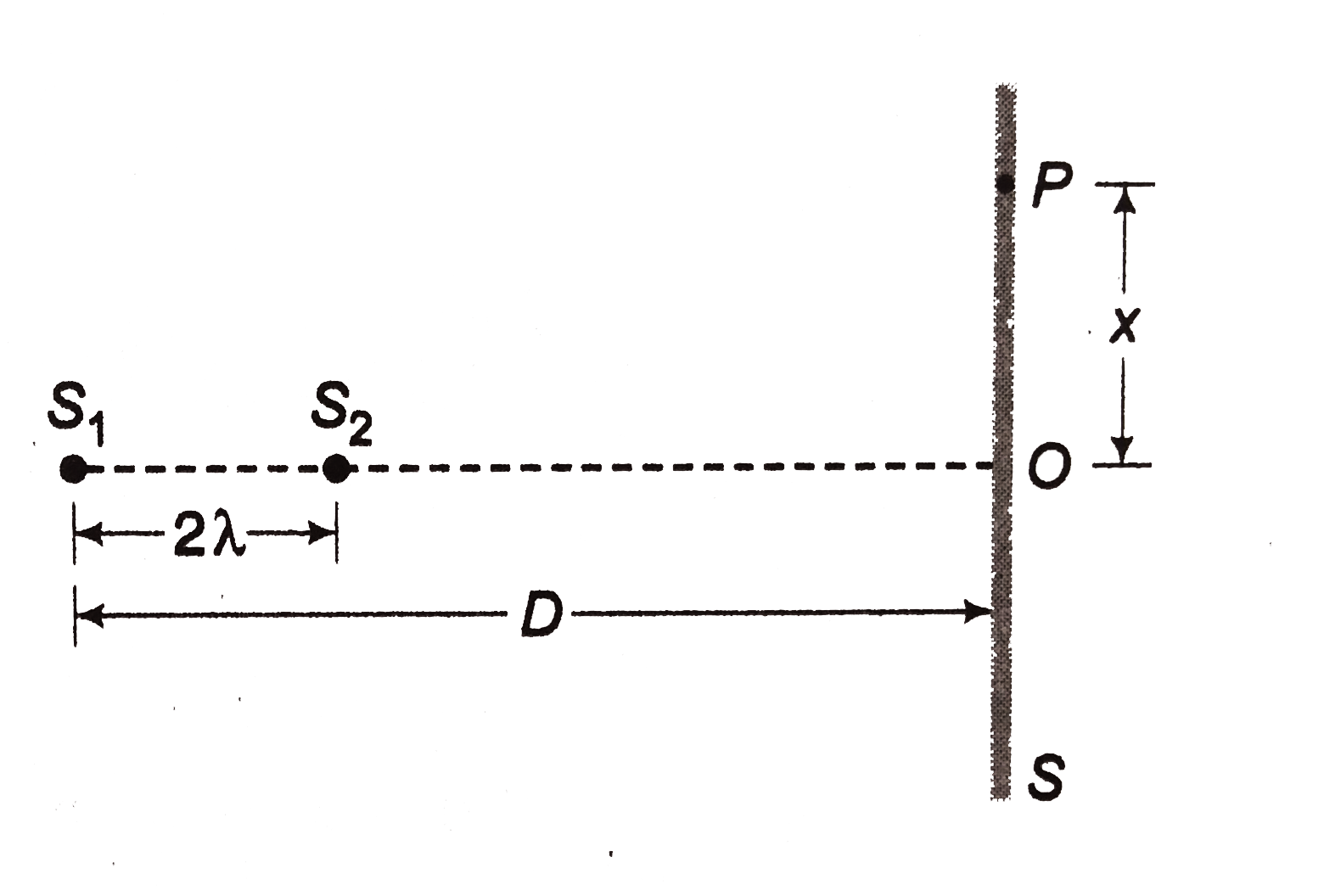
Two coherent narrow slits emitting light of wavelength `lambda` in the same phase are placed parallel to each other at a small separation of `2lambda`. The light is collected on a screen S which is placed at a distance D(`gtgt lambda`) from the slit `S_1` as shown in figure. Find the finite distance x such that the intensity at P is equal to intensity O.
.

Promotional Banner

Similar Questions

Explore conceptually related problems

Two coherent narrow slits emitting light of wavelength lamda in the same phase are placed parallel to each other at a small separation of 3lamda the light is collected on a screen S which is placed at a distance D(gt gt lamda) from the slits the smallest distance x such that the P is a maxima.

Two coherent narrow slits emitting sound of wavelength lambda in the same phase are placed parallet to each other at a small separation of 2 lambda . The sound is delected by maving a delector on the screen at a distance D(gt gt lambda) from the slit S_(1) as shows in figure. Find the distance y such that the intensity at P is equal to intensity at O .

Two coherent point sources S_1 and S_2 vibrating in phase emit light of wavelength lamda . The separation between them is 2lamda . The light is collected on a screen placed at a distance Dgt gt lamda from the slit S_1 as shown. The minimum distance, so that intensity at P is equal to the intensity at O

A narrow slit S transmitting light of wavelength lamda is placed a distance d above a large plane mirror as shown in figure. The light coming directly from the slit and that coming after the reflection interference at a screen sum placed at a distance LD from the slit. a. What will be the intensity at a point just above the mirror. i.e., just above O? b. At what distance from O does the first maximum occur? ?

Consider the situation shown in figure-6.35. The two slits S_(1) and S_(2) placed symmetrically around the central line are illuminated by a monochromatic light of wavelength lambda . The separation between the slits is d. The light transmitted by the slits falls on a screen E_(1) placed at a distance D from the slits. The slit S_(3) is at the central line and the slit S_(4) is at a distance z from S_(3) . Another screen E_(2) is placed a further distance D away from E_(1) . Find the ratio of the maximum to minimum intensity observed on E_(2) if z is equal is : (a) (lambdaD)/(2d) " "(b) (lambdaD)/(d)" " (c )(lambdaD)/(4d)

Consider the situation shown in fig. The two slits S_(1) and S_(2) placed symmetrically around the central line are illuminated by monochromatic light of wavelength lambda . The separation between the slit is d. The ligth transmitted by the slits falls on a screen S_(0) placed at a distance D form the slits. The slit S_(3) is at the central line and the slit S_(4) is at a distance z from S_(3) Another screen S_(c) is placed a further distance D away from S_(c) Find the ratio of the maximum to minimum intensity observed on S_(c) If z = (lambda D)/(2 d)

Consider the situation shown in fig. The two slits S_(1) and S_(2) placed symmetrically around the central line are illuminated by monochromatic light of wavelength lambda . The separation between the slit is d. The ligth transmitted by the slits falls on a screen S_(0) placed at a distance D form the slits. The slit S_(3) is at the central line and the slit S_(4) is at a distance z from S_(3) Another screen S_(c) is placed a further distance D away from S_(c) Find the ratio of the maximum to minimum intensity observed on S_(c) If z = (lambda D)/(4 d)