Home
Class 10
PHYSICS
A beam consisting of red, blue and yello...

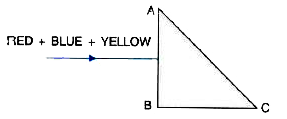
A beam consisting of red, blue and yellow colours is incident normally on the face AB of an isosceles right angled prism ABC as shown in Fig. 6.5. Complete the diagram to show the refracted and the emergent rays. Given that the critical angle of glass-air interface for yellow colour is `45^(@)`

Text Solution

Verified by Experts
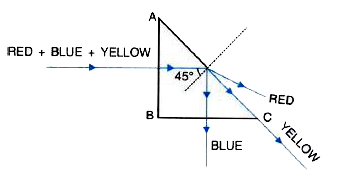
The completed diagram is shown in Fig. 6.6. The beam is incident normally `(angle i = 0^(@))` on the face AB so it passes without deviation `(angle r = 0^(@))` for all colours and with no dispersion. Now the refracted beam inside the prism, strikes the face AC at an angle of incidence equal to `45^(@)`. Since the critical angle for yellow colour at the glass-air interface is `45^(@)`, so the yellow colour suffers refraction along the face AC of the prism `(angle r = 90^(@))`.
The critical angle for the light of red colour will be more than `45^(@)`
`(since sin C=1/mu and mu_(r)
Now the critical angle for the light of blue colour will be less than `45^(@)` since `mu_(B)>mu_(Y)` so the light of blue colour is incident on the glass-air surface AC at an angle of incidence greater than the critical angle for blue colour. Therefore, the light of blue colour suffers total internal reflection and strikes normally on the base BC of the prism. It then emerges out of the prism without deviation. Thus blue colour emerges out of the prism at right angle to its incident direction.
Promotional Banner

Topper's Solved these Questions

  • SPECTRUM

    ICSE|Exercise EXERCISE A|40 Videos
  • SPECTRUM

    ICSE|Exercise EXERCISE A (MULTIPLE CHOICE TYPE)|6 Videos
  • SPECIMEN QUESTION PAPER

    ICSE|Exercise QUESTIONS|33 Videos
  • WORK,POWER AND ENERGY

    ICSE|Exercise DIAGRAM BASED MCQ|3 Videos

Similar Questions

Explore conceptually related problems

A ray of light incident normally on an isosceles right angled prism travels as shown in the figure. The least value of the refractive index of the prism must be

A ray of light PQ is incident normally on the hypotenuse of a right angled prism ABC as shown in the diagram given below: What is the value of the angle of deviation of the ray ?

Complete the ray diagram shown below, given that the critical angle. for air-glass pair is i_(c)=42^(@)

A ray of light PQ is incident normally on the hypotenuse of a right angled prism ABC as shown in the diagram. Name an instrument where this action of the prism is used.

A light ray is incident normally on the face AB of a right-angled prism ABC (mu==1.50) as shown in figure. What is the largest angle phi for which the light ray is totally reflected at the surface AC ?

A ray of light PQ is incident normally on the hypotenuse of a right angled prism ABC as shown in the diagram given below: Copy the diagram and complete the path of the ray PQ till it emerges from the prism.

A ray of light PQ is incident normally on the hypotenuse of a right angled prism ABC as shown in the diagram given below: Name an instrument where this action of the prism is used.

Two monochromatic ray of light are incident normally on the face AB of an isosceles right - angled 'I' and '2' are respectively 1.35 and 1.45. Trace path of these rays after entering through the prism.

Complete the path of the ray AB through the glass prism in PQR till it emerges out of the prism. Given the critical angle of the glass as 42^(@) .

A ray of light LM incident normally on the surface AC of an isosceles right angled prism ABC (where AB=BC) emerges along PQ, parallel to LM, as shown in given figure. What can you say about refractive index mu of the material of the prism ?

