Home
Class 10
PHYSICS
A beam of white light is incident normal...

A beam of white light is incident normally on the surface AB of an equilateral prism ABC and emerges out of it suffering a deviation of `60^(@)`.
(a) Draw a diagram to show the path of beam till it emerges out of the prism. Mark the angles wherever necessary.
(b) What assumption have you made while drawing the diagram ?
(c) Name the phenomenon exhibited by the light beam.

Text Solution

Verified by Experts
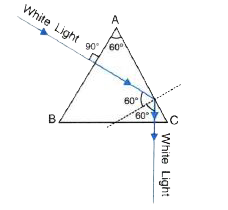
(a) The ray diagram is shown in Fig. 6.7. The beam of white light incident normally on the face AB of the prism passes undeviated inside the prism and strikes the other face AC at an angle of incidence of `60^(@)` At the face AC, it suffers total internal reflection. After total internal reflection at

the face AC, the beam of light falls normally on the face BC, so it emerges out without deviation.
(b) Assumption : The critical angle of glass-air interface is less than `60^(@)` for all colours of whitelight.
(c) Phenomenon : Total internal reflection.
Promotional Banner

Topper's Solved these Questions

  • SPECTRUM

    ICSE|Exercise EXERCISE A|40 Videos
  • SPECTRUM

    ICSE|Exercise EXERCISE A (MULTIPLE CHOICE TYPE)|6 Videos
  • SPECIMEN QUESTION PAPER

    ICSE|Exercise QUESTIONS|33 Videos
  • WORK,POWER AND ENERGY

    ICSE|Exercise DIAGRAM BASED MCQ|3 Videos

Similar Questions

Explore conceptually related problems

A beam of white light is incident on a hollow prism of glass. Then

A ray of light falls normally on a rectangular glass slab. Draw a ray diagram showing the path of the ray till it emerges out of the slab.

A ray of light PQ is incident normally on the hypotenuse of a right angled prism ABC as shown in the diagram given below: Copy the diagram and complete the path of the ray PQ till it emerges from the prism.

In figure, a ray of light PQ is incident normally on the hypotenuse of an isosceles right angled prism ABC. (a) complete the path of the ray PQ till it emerges from the prism. Mark in the diagram the angle wherever necessary. (b) what is the angle of deviation of the ray PQ ? (c) Name a device in which this action is used.

A beam of monochromatic light is incident at i= 50^(@) on one face of an equilateral prism, the angle of emergence is 40^(@) , then the angle of minimum deviation is :

Figure below shows a light ray of green colour incident on the prisms A,B and C. in each case, draw the path of the ray of light as it enters and emergest out of the prism. Mark the angle wherever necessary.

A ray of light falls normally on a glass slab. Draw a diagram showing the path of the ray till it emerges out of the slab. What is the angle of incidence and angle of refraction at each surface of slab ?

A ray LM of monochromatic light incident normally on one refracting surface AB of a regular glass prism ABC emerges in air from the adjacent surface C as shown in figure. Calculate the refractive index of the material of the prism.

A ray of light PQ is incident normally on the hypotenuse of a right angled prism ABC as shown in the diagram given below: What is the value of the angle of deviation of the ray ?

Complete the path of the monochromatic light ray AB incident on the surface PQ of the equilateral glass prism PQR till it emerges out of the prism due to refraction.

