

Home
Class 9
PHYSICS
Draw a ray diagram to show the formation...

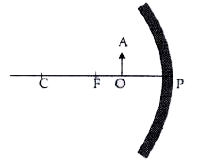
Draw a ray diagram to show the formation of image by a concave mirror for an object placed between its pole and focus. State three characteristics of the image.

Promotional Banner

Topper's Solved these Questions

  • REFLECTION OF LIGHT

    ICSE|Exercise EXERCISE 7(B)|9 Videos
  • PROPAGATION OF SOUND WAVES

    ICSE|Exercise EXERCISE -8(B) (Multiple choice type)|3 Videos
  • SOUND

    ICSE|Exercise TOPIC 2 Infrasonic and Ultrasonic Waves ( 3 Marks Questions) |3 Videos

Similar Questions

Explore conceptually related problems

Draw a ray diagram to show the formation of image by a concave mirror for an object beyond its centre of curvature. State three characteristics of the image.

Draw a ray diagram to show the formation of the image as specified in the part a.

By drawing a neat diagram show the formation of an image in a concave mirror when the object is between the pole and the principal focus of the mirror. State the characteristics of the image.

Draw a ray diagram showing the formation of image of a point object by a plane mirror.

Draw ray diagrams showing the image formation by a concave mirror when an object is placed (a) between pole and focus of the mirror , (b) between focus and centre of curvature of the mirror (c) at centre of curvature of the mirror , (d) a little beyond centre of curvature of the mirror (e) at infinity

Copy and complete the ray diagram to show the formation of the image of the object AB

Draw the image formed by a convex mirror when the object is kept in front of the mirror and write the characteristics of the image.

Draw ray diagrams showing the image formation by a concave lens when an object is placed (a) between focus and twice the focal length of the lens (b) beyond twice the focal length of the lens

Draw ray diagrams showing the image formation by a convex mirror when an object is placed (a) at infinity (b) at finite distance from the mirror

Draw ray diagrams showing the image formation by a convex lens when an object is placed (a) between optical centre and focus of the lens (b) between focus and twice the focal length of the lens ( c) at twice the focal length of the lens (d) at infinity , (e) at the focus of the lens

ICSE-REFLECTION OF LIGHT-EXERCISE 7(C)
  1. Complete the following diagrams in Fig. by drawing the reflected ray f...

    Text Solution

    |

  2. State the two convenient rays that are chosen to construct the image b...

    Text Solution

    |

  3. Draw a ray diagram to show the formation of image by a concave mirror ...

    Text Solution

    |

  4. Draw a ray diagram to show the formation of image by a concave mirror ...

    Text Solution

    |

  5. Draw the image formed by a convex mirror when the object is kept in fr...

    Text Solution

    |

  6. Name the mirror which always produces an erect and virtual image. How ...

    Text Solution

    |

  7. (a) For what position of object, the image formed by a concave mirror...

    Text Solution

    |

  8. (a) For what position of object, the image formed by a concave mirror...

    Text Solution

    |

  9. State the position of object for which the image formed by a concave ...

    Text Solution

    |

  10. Write two more characteristics of the image.

    Text Solution

    |

  11. What is a real image?

    Text Solution

    |

  12. What type of mirror can be used to obtain a real image of an object?

    Text Solution

    |

  13. Does the mirror mentioned in part b. form real image for all locations...

    Text Solution

    |

  14. Write the position and nature of the image formed in a concave mirror ...

    Text Solution

    |

  15. Name the kind of mirror used to obtain: a. a real and enlarged image...

    Text Solution

    |

  16. How is the focal length of a spherical mirror related to its radius of...

    Text Solution

    |

  17. Write the spherical mirror's formula and explain the meaning of each s...

    Text Solution

    |

  18. What is meant by magnification ? Write its expression. What is its sig...

    Text Solution

    |

  19. What may be the maximum distance of the image in a convex mirror can ...

    Text Solution

    |

  20. Upto what maximum distance from a concave mirror, the image can be obt...

    Text Solution

    |