Home
Class 12
PHYSICS
Two parallel forces F(1) and F(2) acting...

Two parallel forces `F_(1)` and `F_(2)` acting in the same direction are applied to a rigid body.
Porve that
(a) the magnitude of the resultant force is equal to the sum of magnitudes of the forces being added,
(b) the resultant force is parallel to the forces being added and acts in the same direction,
(c ) the resultant force passes through the centre of the parallel forces, i.e. through the point which divides the distance between the points of application of both forces into sections inversely proportional to the magnitude of the forces.

Text Solution

Verified by Experts
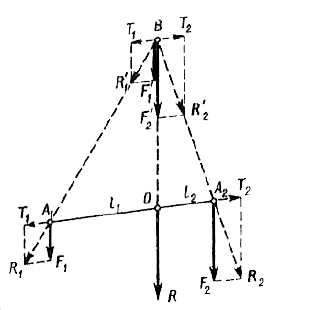
Apply to the body two forces `T_(1)` and `T_(2)` equal in magnitude and opposite in direction (Fig.).

Adding up the forces `F_(1) and T_(1) and F_(2) and T_(2)`, respectively, we obtain two forces `R_(1) and R_(2)` intersecting in point B. Translate the forces `R_(1) and R_(2)` to this point and resolve them again into the former components. The forces `T_(1) and T_(2)` are in equilibrium, but the forces `F._(1)=F_(1), and F._(2)=F_(2)` act in the same direction and their resultant force `R=F._(1)+F._(2)=F_(1)+F_(2)`.
The position of point O, the centre of parallel forces, may be found from the similarity of triangles. From the condition `DeltaA_(1)OB ~DeltaF._(1)R._(1)B and DeltaA_(2)OB ~ DeltaF._(2)R._(2)B`
we obtain
`(l_(1))/(T) =(OB)/(F_(1)) and (l_(2))/(T)=(OB)/(F_(2))`
from which `l_(1)F_(1) = l_(2)F_(2) `, which was required to prove.
Promotional Banner

Similar Questions

Explore conceptually related problems

If two equal forces act on the body in opposite direction, then the resultant force on the body will be

Two equal forces are acting at a point with an angle of 60° between them. If the resultant force is equal to 30sqrt(3) N, the magnitude of each force is

Sum of magnitudes of the two forces acting at a point is 16 N if their resultant is normal to the smaller forces and has a magnitude 8N then the forces are .

Two equal forces are acting at a point with an angle 60^(@) between them. If the resultant force is equal to 4sqrt(3)N , the magnitude of each force is

Two equal forces are acting at a point with an angle of 60^(@) between them. If the resultant force is equal to 40sqrt3 N, the magnitude of each force is

Two forces each of magnitude 2N, act at an angle of 60^(@) . What is the magnitude of the resultant force ?

Two equal forces are acting at a point with an angle of 60^(@) between them. If the resultant force is equal to 40sqrt(3)N , The magnitude of each force is :-

If the resultant of the two forces has a magnitude smaller than the magnitude of larger force ,then two forces must be

What is the resultant force when two forces act in same direction?

