Home
Class 12
PHYSICS
Find the position of the centre of two u...

Find the position of the centre of two unequal antiparallel forces. The distance between the points of application of the forces `F_(1)` and `F_(2)` is a.

Text Solution

Verified by Experts

The correct Answer is:
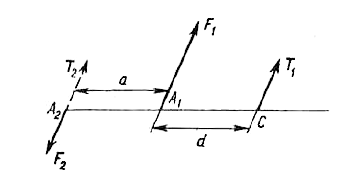
`d=F_(2)a//(F_(1)-F_(2))`

Resolve the greater force `F_(1)` into two parallel components (Fig.), applying the force `T_(2)= -F_(2)` at the point `A_(2)` and the second force `T_(1)` of magnitude `T_(1)=F_(1)-F_(2)` at the point C at a distance

`d=a T_(2)//T_(1)` from point `A_(1)`. Since the forces `F_(2)` and `T_(2)` are in equilibrium, the resultant `R=T_(1)`, its magnitude is `R=T_(1)=F_(1)-F_(2)`.
Promotional Banner

Similar Questions

Explore conceptually related problems

A thin uniform rod AB of mass 1 kg moves translationally with acceleration a=2m//s^(2) due to two antiparallel forces F_(1) & F_(2) . The distance between the points at which these forces are applied is equal to l=0.2m. If force F-(1)=8N then find the length of the rod in meter

A Thin uniform rod AB of mass m=1.0kg moves translationally with acceleration a=2.0 m//s^(2) due to two antiparallel forces F_(1) and F_(2) . The distance between the points at which these forces are applied is equal to d=20 cm . Besides, it is known that F_(2)=5.0 N . Find the length of the rod.

A thin uniform rod AB of mass m=1kg moves translationally with acceleration a=2m//s^(2) and to two anitiparallel forces F_(1) and F_(2) . The distance between the points at which these forces are applied is equal to l=20cm besides it is known that F_(2)=5N find the length of the rod.

A thin uniform rod AB of mass m=1.0kg moves translationally with acceleration w=2.0m//s^2 due to two antiparallel forces F_1 and F_2 (figure). The distance between the points at which these forces are applied is equal to a=20cm . Besides, it is known that F_2=5.0N . Find the length of the rod.

What is the tension in a rod of length length L and mass M at a distance y from F_(1) when the rod is acted on by two unequal force F_(1) and F_(2) ( lt F_(1)) as shown in.

