Home
Class 12
PHYSICS
A block of mass m is placed on wedge of ...

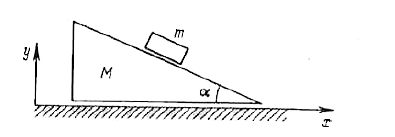
A block of mass m is placed on wedge of mass M (Fig.). Find the accelerations of the block and the wedge in the reference system fixed to the table, and the reaction. Friction is to be neglected.
Analyse the limiting case when the wedge remains stationary.

Text Solution

Verified by Experts

The correct Answer is:
`a_(x)="g"(M sin alpha cos alpha)/( M + m sin^(2)alpha) , a_(y) = ((M+m) sin^(2)alpha)/(M+m sin^(2)alpha)`
`b_(x)= -"g"(m sin alpha cos alpha)/(M+m sin^(2)alpha); Q=(mMg)/(M+m sin^(2)alpha)`.

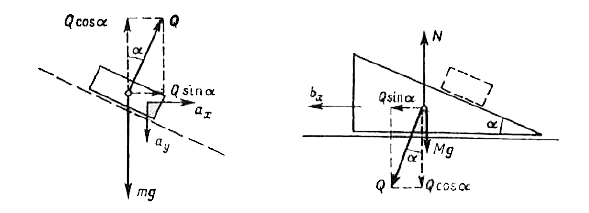
The problem reduces to the solution of a system of four equations:
`-Q sin alpha = Mb_(x) , " " -mg + Q cos alpha = m a_(y)`
`Q sin alpha = ma_(x), " " a_(y) = (-a_(x) +b_(x)) tan alpha`
The case of a fixed wedge may be considered separately, but it may also be obtained from the general case, if we put `m lt lt M`.We obtain
`a_(x)=g sin alpha cos alpha, a_(y^(-)) - g sin^(2)alpha`
`a = sqrt(a_(x)^(2) +a_(y)^(2)) = g sin alpha, Q= mg cos alpha`
Promotional Banner

Similar Questions

Explore conceptually related problems

A rod of mass m is supported on a wedge of mass M shown in fig. Find the accelerations of rod a and wedge A in the arrangment. The friction between all contact surfaces in negligible.

A block of mass m is released from a wedge of mass m as shown in figure . Find the time taken by the block to reach the end of the wedge.

A block of mass m=5 kg is placed on the wedge of mass M=32 kg as shown in the figure. Find the acceleration of wedge with respect to ground. (Neglect any type of friction. String and pulley are ideal )

a Block of mass m is placed on a wedge of mass M there is no friction between the block and the wedge .The minmum coefficient of friction between the wedge and the gound so that wedge does not move is,

A block of mass m is at rest on a rought wedge as shown in figure. What is the force exerted by the wedge on the block?

A block of mass m is placed at rest on a smooth wedge of mass M placed at rest on a smooth horizontal surface. As the system is released

A block of mass m is placed on the inclined sufrace of a wedge as shown in fig. Calculate the acceleration of the wedge and the block when the block is released. Assume all surfaces are frictionless.

A block of mass m is placed on a smooth wedge of inclination theta & mass M. The whole system is slip on the wedge. Then the normal reaction on the wedge acting from the ground :

