Home
Class 12
PHYSICS
An electric field of intensity E is set ...

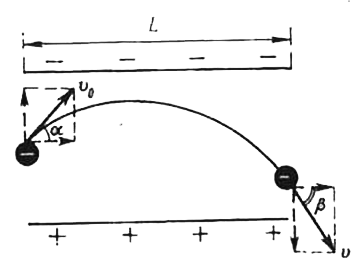
An electric field of intensity E is set up between two parallel plates of length L. An electron beam enters the field at an angle `alpha gt 0` to the plates and leaves it at an angle `beta lt 0` (Fig.). Find the initial velocity of the electrons. The force of gravity is to be neglected.

Text Solution

Verified by Experts

The correct Answer is:

`v_(0)= sqrt((eEL cos beta)/(m cos alpha sin (alpha-beta)))`

Since there are no forces in the direction of the x-axis acting on the electron (we neglect the force of gravity), `v_(x)=` const, and the electron transit time in the field is `t=L//v_(x)`. The force acting on the electron in the direction of the y-axis is `F_(y) = - eE`. This force imparts to the electron an acceleration `a_(y)= -eE//m`. The projection of the velocity on the y-axis varies with time according to the equation `v_(y)= v_(0y)+a_(y)t`. At the point of the electron.s exist from the field we have
`v_(x) tan beta = v_(x) tan alpha - (e EL)/(mv_(x))`, from which `v_(x)^(2)(tan alpha-tan beta)=(e EL)/(m)`
Since `v_(x)=v_(0) cos alpha`, we obtain
`v_(0)^(2)cos^(2)alpha (tan alpha-tan beta)= eEL//m`
Promotional Banner

Similar Questions

Explore conceptually related problems

A uniform electric field E is created between two parallel ., charged plates as shown in figure . An electron . enters the field symmetrically between the plataes with a . speed v_0. The length of each plate is l. Find the angle of . deviation of the path of the electron as it comes out . of the field.

IF an electorn enters into a space between the plates of a parallel plate capacitor at an an angle alpha with the plates an leaves at an angle beta to the plates find the ratio of its kinetic energy while entering the capacitor of that while leaving.

A uniform electric field E is established between two parallel charged plates as shown in figure. An electron enter the field symmetrically between the plates with a speed u. The length of each plate is l. if the electron does not stricke any of the plates, find the angle of deviation of the electron as it comes out of the field at the outer end of plates. [tan^(-1) ((eEl)/(mu^(2)))]

[" 0.A electric field of "1.5times10^(4)NC^(-1)" exists "],[" between two parallel plates of length "2cm." An "],[" electron enters the region between the plates "],[" at right angles to the field with a kinetic energy "],[" of "E_(k)=2000eV." The deflection that the "],[" electron experiences at the deflecting plates "],[" is "]

An electron is projected with an initial velocity of 10^(7)ms^(-1) into an electric field between two parallel plates 1 cm apart. The electron enters the field at a point midway between the plates. If the electron just misses the positivity charged plate as it emerges from the field, find the magnnitude of the electric density between the plates. (Length of each plate is 2 cm, mass of electron= 9xx10^(-31) kg and charge of electron =1.6xx10^(-19) C)

A uniform electric field E=91xx10^(-6) V//m is created between two parallel, charged plates as shown in figure. An electron enters the field symmetrically between the plates with a speed v_(0)=4xx10^(3) m//s . The length of each plates is l=1m . Find the angle of deviation of the path of the electron as it comes out of the field. (Mass of the electron is m=9.1xx10^(-31) kg and its charge is e=-1.6xx10^(-19) C ).

A uniform electric field 'E' exists between two parallel plates having opposite having opposite charge on each plates. An electron enters the field between the plates with speed v_0 as shown in the figure. If length of each plate is l then angle with which electron deviates from its initial path is (m is mass of electron ) (##AAK_TST_05_NEET_YEAR(19)_PHY_E05_133_Q01##)

Two charged metal plates in vacuum are 10cm apart. A uniform electric field of intensity (45//16)xx10^(3)NC^(-1) is applied between the plates. An electron is released between the plates from rest at a point just outside the negative plate. (a) Calculate how long (t) will the electron take to reach the other plate? (b) At what velocity (v) will it be electron take to hits teh other plate?
