Home
Class 12
PHYSICS
The coefficient of friction between the...

The coefficient of friction between the block and the inclined plane is `mu`.

Text Solution

Verified by Experts

The correct Answer is:
`a="g"(m-M(sin alpha pm mu cos alpha))/(m+M)`

Since the force of sliding friction T is opposite in direction to that of the block.s motion, the result will be essentially dependent on the initial direction of the block velocity. Consider all the possible cases.
Let the initial velocity of teh weight be directed downwards (Fig.). The equations of motion will be of the form
`mg - F = ma`
`F-T-Mg sin alpha= Ma`, where `T= muQ=muMg cos alpha`
Hence
`a= "g"(m-M(sin alpha +mu cos alpha))/(m+M) , F=(mMg(1+sin alpha +mu cos alpha))/(m+M)`
If `m gt M (sin alpha + mu cos alpha)`, then `a gt 0` and the speed of the system increases. If `m lt M (sin alpha +mu cos alpha)`, then `a lt 0`, and the speed
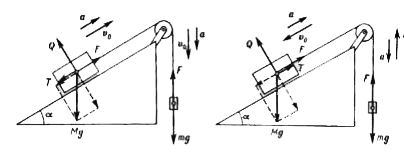
of the system decreases. Lastly, when `m=M(sin alpha +mu cos alpha)`, we have a = 0, and the system moves at a constant speed.
(2) Let the initial velocity of the weight be directed upwards (Fig.). Then, as may easily be inferred,
`a="g"(m-M(sin alpha - mu cos alpha))/(m+M), F= (mMg(1+sin alpha- mu cos alpha))/(m+M)`
If `m gt M(sin alpha- mu cos alpha)`, then `a gt 0`, and the speed of the system decreases. If `m lt M(sin alpha - mu cos alpha)`, then `a lt 0`, and the speed of the system moves at a constant speed.
(3) Finally, let the system be at rest. Then a force of static friction will act between the block and the inclined plane, its direction being dependent on the direction in which the system would move in the absence of friction. If `m gt M sin alpha`, the block in th absence of friction moves upwards. Therefore the force of static friction is directed downwards, as in Fig. If `m lt M sin alpha`, the block in the absence of friction moves downwards, and for this reason the force of static friction is directed upwards, as in Fig.
If one analyses the two preceding cases, one can easily see that for `m gt M (sin alpha +mu cos alpha)` the black will move up the inclined plane with an acceleration, for `m lt M(sin alpha- mu cos alpha)` it will move down the inclined plane with an acceleration, will for
`M (sin alpha- mu cos alpha) le m le M(sin alpha+mu cos alpha)`
the system will remain at rest.

Promotional Banner

Similar Questions

Explore conceptually related problems

A block of mass 0.1 kg is kept on an inclined plane whose angle of inclination can be varied from theta = 30^(@) to theta = 90^(@) . The coefficient of friction between the block & the inclined plane is mu =1 . A force of constant magnitude (1)/(2)mg newton always acts on the block directed up the inclined plane and parallel to it. Then :

An inclined plane of angule a is fixed onto a horizontal turntable with its line of greater slope in same plane as a diameter of forntable .A small block is placed on the inclined plane a distance r from the axis the coefficient of fraction between the block and the inclined plane is mu The turntable along with incline plane spins about its axis with constant minimum angular velocity omega a. Find an capression for the minimum angular velocity omega to prevent the block from sliding down the plane in term of g, r, mu and the plane omega b. Now a block of mass but having coefficient friction (with inclined plane) 2mu is kept instead of the original block . find the radius of friction force acting between block and incline now to the friction force active in part (a)

A block of mass m is at rest on a rough inclined plane of angle of inclination theta . If coefficient of friction between the block and the inclined plane is mu , then the minimum value of force along the plane required to move the block on the plane is

A block of mass m is placed on a rough plane inclined at an angle theta with the horizontal. The coefficient of friction between the block and inclined plane is mu . If theta lt tan^(-1) (mu) , then net contact force exerted by the plane on the block is :

In the figure shown, a spring of spring constant K is fixed at on end and the other end is attached to the mass 'm' . The coefficient of friction between block and the inclined plane is mu . The block is released when the spring is in tis natural length. Assuming that the theta gt mu , the maximum speed of the block during the motion is.

Two block of masses M_(1) and, M_(2) are connected with a string which passed over a smooth pulley . The mass M_(1) is placed on a tough inclined plane as shown in figure .The coefficient of friction between and block and the inclined plane is mu what should be the minimum mass M_(2) so that the block M_(1) slides upwards?

A small blockofmass 'm' is released from rest at the top of a rough inclined plane as shown The coefficient of friction between the block and inclined plane is 'mu' Using work-energy theorem, find the speed of block as it passes the lowest point.

A block rests on a rough inclined plane making an angle of 30° with the horizontal. The coefficient of static friction between the block and inclined plane is 0.8. If the frictional force on the block is 10 N, the mass of the block is

A block is stationary on an inclined plane If the coefficient of friction between the block and the plane is mu then .
