Home
Class 12
PHYSICS
The coefficient of friction between the ...

The coefficient of friction between the wedge and the table is `mu`, the friction between the rod and the wedge being negligible.

Text Solution

Verified by Experts

The correct Answer is:
`Q=(m_(1)m_(2)g cos(alpha-varphi))/(m_(1) cos^(2) alpha cos varphi +m_(2) sin alpha sin(alpha-varphi)); varphi="arctan "mu`.

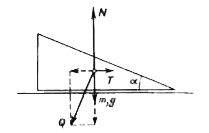
The equation of motion of the rod will remain unaltered, in the equation of motion of the wedge on should take into account the presence of the force of kinetic friction `T = mu (Q cos alpha +m_(1)g)`,

directed opposite to the acceleration (Fig.). Thus
`-m_(2)g+Q cos alpha =m_(2)a_(y), -Q sin alpha +mu(Q cos alpha+m_(1)g) = m_(1) a_(x)`
After some transformations, noting that `a_(y)= a_(x) tan alpha`, we obtain
`Q=(m_(1)m_(2)g (cos alpha+mu sin alpha))/(m_(1) cos^(2)alpha+m_(2)sin^(2)alpha-mu m_(2)sin alpha cos alpha)`
`a_(x)= (-m_(2)g +mu g cot alpha(m_(2)+m_(1)))/(m_(1)cot alpha+m_(2)tan alpha+mu m_(2)) lt 0`
`a_(y) = (-m_(2)g tan alpha +mu g (m_(2) +m_(1)))/(m_(1)cot alpha +m_(2) tan alpha -mu m_(2)) lt 0`
The solution makes sense when
`m_(1) cot alpha +m_(2) tan alpha gt mu m_(2), m_(2) tan alpha gt mu(m_(2) +m_(1))`
It follows from the second inequality that
`tan alpha gt (mu(m_(2)+m_(1)))/(m_(2))`
If , on the other hand, `tan alpha le (mu(m_(2) +m_(1)))/(m_(2))` then `a_(x)= 0, a_(y)=0` and `Q=(m_(2)g)/(cos alpha)`.
Promotional Banner

Similar Questions

Explore conceptually related problems

A block A of mass m which is placed a rough inclined face of a wedge of same mass being pulled through light string and with force F as shown in figure The coefficient of friction between inclined face and block A is mu while there is no friction between the ground and wedge it the whole system moves with same acceleration then find the value of F

A ball of mass M is in equilibrium between a vertical wall and the inclined surface of a wedge. The inclination of the wedge is theta = 45^(@) and its mass is very small compared to that of the ball. The coefficient of friction between the wedge and the floor is mu and there is no friction elsewhere. Find minimum value of mu for which this equilibrium is possible

Block A of mass m and block B of mass 2m are placed on a fixed triangular wedge by means of a light and inextensible string and a frictionless pulley as shown in fig . The wedge is inclined at 45^(@) to the horizontal on both sides . The coefficient of friction between the block A and the wedge is 2//3 and that between the block B and the wedge is 1//3 .If the system of A and B is released from rest then find . a. the acceleration of A b. tension in the string c.the magnitude and direction of the frictional force acting on A

A homogoneous chain of length L lies on a table. The coefficient of friction between the chain and the table is mu . The maximum length which can hang over the table in equilibrium is

A block of mass m slips on a rough horizontal table under the action of horiozontal force applied to it. The coefficient of friction between the block and the table is mu . The table does not move on the floor. Find the total frictional force aplied by the floor on the legs of the table. Do you need the friction coefficient between the table and the floor or the mass of the table ?

Wedge is fixed on horizontal surface. Block A is pulled upward by applying a force F as shown in figure and there is no friction between the wedge and the block A while coefficient of friction between A and B is mu . If there is no relative motion between the block A and B then frictional force developed between A and B is

