Home
Class 12
PHYSICS
A spherical bowl of radius R rotates abo...

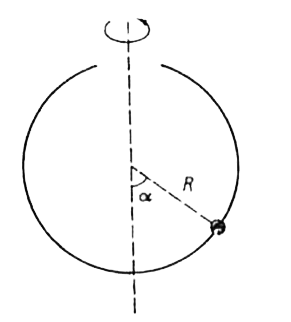
A spherical bowl of radius R rotates about the vertical diameter. The bowl contains a samll object whose radius vector in the course of rotation makes an angle `alpha` with the vertical (Fig.). What should be the minimum angular velocity `omega` of the bowl in order to prevent the object from sliding down, if the coefficient of static friction is `mu^("stat")`?

Text Solution

Verified by Experts

The correct Answer is:
`sqrt((g tan (alpha-varphi))/(R sin alpha)) le omega le sqrt((g tan (alpha+varphi))/(R sin alpha))`, where `varphi="arc tan"mu`

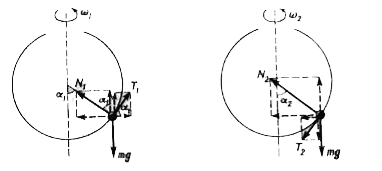
Since the object is at rest, the direction of the force of friction is not known. For this reason we shall imagine the angular velocity to be decreased until the object starts sliding downwards. The force of friction will then be directed as shown in Fig. The equations of motion are of the form
`N sin alpha - T cos alpha - m omega^(2)R sin alpha`
`N Cos alpha | T sin alpha - mg = 0`
where `T= mu^("stat")= tan varphi` we obtain after some simple transformations
`omega_(1)= sqrt((g tan (alpha-varphi))/(R sin alpha))`
Suppose we imagine the angular velocity to be increased, so that the object starts sliding upwards. Then the direction of the force of
friction will change sign (Fig.) and the equations of motion will assume the form
`N sin alpha + T cos alpha = m omega^(2) R sin alpha`
`N cos alpha - T sin alpha - mg = 0`
`T = mu^("stat")N = N tan varphi`
from which we get
`omega_(2) = sqrt((g tan (alpha+varphi))/(R sin alpha))`
Thus the body will be in equilibrium if
`sqrt((g tan (alpha-varphi))/(R sin alpha)) le omega le sqrt((g tan (alpha+varphi))/(R sin alpha)) `
Obviously, if `alpha le varphi`, i.e. if `tan alpha le mu^("stat")`, the object will not slide down, even when the bowl stops rotating.
As a particular case of the solution when static friction is absent `(mu^("stat")=tan varphi = 0)` equilibrium will be established when the bowl rotates at an angular velocity of
`omega_(0)= sqrt(g//R cos alpha)`
Promotional Banner

Similar Questions

Explore conceptually related problems

A circular wire frame of radius R is rotating about its fixed vertical diameter. A bead on the wire remains at rest relative to the wire at a position in which the radius makes an angle theta with the vertical (see figure). There is no friction between the bead and the wire frame. Prove that the bead will perform SHM (in the reference frame of the wire) if it is displaced a little from its equilibrium position. Calculate the time period of oscillation.

A hemisphericla bowl of rdius R is rotated about its axis of symetry which is kept vertical.A small block is kept in the bowl at a position where the radius makes an angle theta with the vertical. The block rottes with the bowl without any sliping. The friction coefficient between the block and teh bowl surface is mu . Find the range of the angular speed for which the block will not slip.

A chain of mass 'm' and radius 'r' is placed onto a cone of semi vertical angle theta . Cone rotated with angular velocity omega . Find the tension in the chain if it does not slide on the cone.

In the motorcycle stunt called " the well of death" the track is vertical cylindrical surface of 18 m radius.take the motorcyle to be a point mass and mu=0.8 . The minimum angular speed of the motorcycle to prevent him from sliding down should be

An inclined plane of angule a is fixed onto a horizontal turntable with its line of greater slope in same plane as a diameter of forntable .A small block is placed on the inclined plane a distance r from the axis the coefficient of fraction between the block and the inclined plane is mu The turntable along with incline plane spins about its axis with constant minimum angular velocity omega a. Find an capression for the minimum angular velocity omega to prevent the block from sliding down the plane in term of g, r, mu and the plane omega b. Now a block of mass but having coefficient friction (with inclined plane) 2mu is kept instead of the original block . find the radius of friction force acting between block and incline now to the friction force active in part (a)

A thin circular wire of radius R rotatites about its vertical diameter with an angular frequency omega . Show that a small bead on the wire remain at its lowermost point for omegalesqrt(g//R) . What is angle made by the radius vector joining the centre to the bead with the vertical downward direction for omega=sqrt(2g//R) ? Neglect friction.

A metal disc of radius R can rotate about the vertical axis passing through its centre. The top surface of the disc is uniformly covered with dust particles. The disc is rotated with gradually increasing speed. At what value of the angular speed (omega) of the disc the 75% of the top surface will become dust free. Assume that the coefficient of friction between the dust particles and the metal disc is mu = 0.5 . Assume no interaction amongst the dust particles.

A particle of mass m is released from the edge of a rough bowl of radius r. It momentrially comes to rest at point B, whose radius vector making an angle 30^(@) with the vertical . If mu=(1)/(sqrt(3)) , then work done by the frictional force on the particle is

