

Home
Class 12
PHYSICS
A ball is projected from the floor of a ...

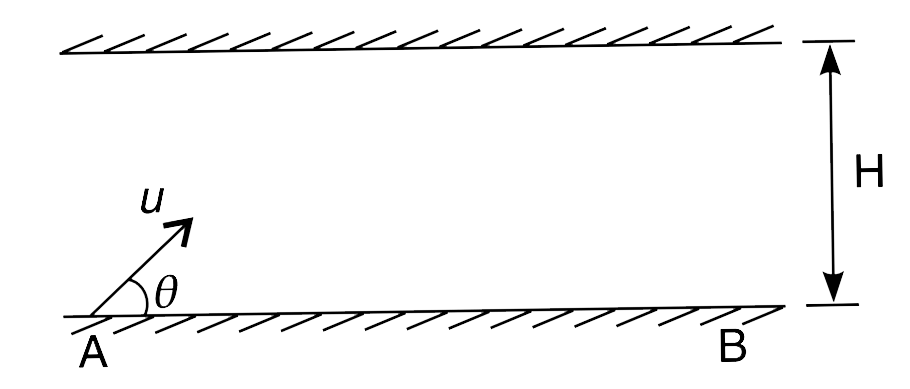
A ball is projected from the floor of a long hall having a roof height of `H = 10 m`. The ball is projected with a velocity of `u = 25 ms^(–1)` making an angle of `theta = 37^(@)` to the horizontal. On hitting the roof the ball loses its entire vertical component of velocity but there is no change in the horizontal component of its velocity. The ball was projected from point A and its hits the floor at B. Find distance AB.

Promotional Banner

Similar Questions

Explore conceptually related problems

A ball is projecte with a velocity 20 ms^-1 at an angle to the horizontal. In order to have the maximum range. Its velocity at the highest position must be

A boy throws a ball with velocity v_(0) =10sqrt2 m//s at an angle of 45^(@) as shown in the figure .After collision with the ball the vertical component of ball's velocity is unchanged and the horizontal. Component is reversed in direction .Where does the ball hit the ground?

A ball is thrown with a velocity of u making an angle theta with the horizontal. Its velocity vector normal to initial vector (u) after a time interval of

A ball is projected form top of a tower with a velocity of 5m//s at an angle of 53^(@) to horizontal. Its speed when it is at a height of 0.45m from the point of projection is:

A ball is thrown with velocity 8 ms^(-1) making an angle 60^(@) with the horizontal.Its velocity will be perpendicular to the direction of initial velocity of projection after a time of

A ball is projected with initial velocity u at an angle theta to the horizontal. Then horizontal displacement covered by ball as it collides third time to the ground would be, if coefficient of restitution is e :

A ball of mass m is projected from the ground with an initial velocity u making an angle of theta with the vertical. What is the change in velocity between the point of projection and the highest point ?

A ball projected with a velocity of 28m/sec has a horizontal range 40m. Find the two angles of projection.

A volleyball is spiked so that it has an initial velocity of 15 m/s directed downward at an angle of 55^(@) below the horizontal. What is the horizontal component of the ball's velocity when the opposing player fields the ball?