
Home
Class 12
PHYSICS
Complete the following table for a radio...

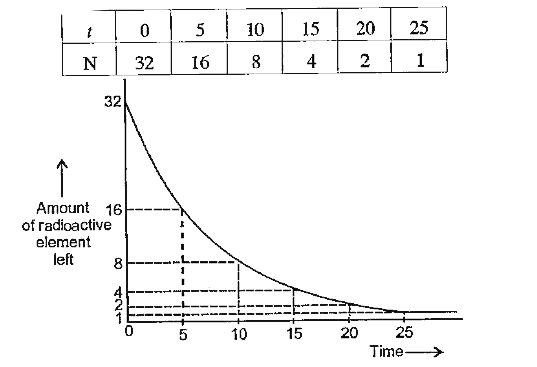
Complete the following table for a radioactive element whose half life is 5 minutes. Assume that you have 32 8 of this element at start, i.e., at t=0.

Now, using this data, plot the "decay curve"

Text Solution

Verified by Experts
Promotional Banner

Similar Questions

Explore conceptually related problems

Copy and complete the following table for a radioactive element whose half-life is 10 minutes. Assume that you have 30g of this element at t= 0.

The half-life period of a radioactive element is 140 days. After 560 days, 1g of the element will reduce to a. 0.5 g b. 0.25 g c. 1//8 g d. 1//16 g

Ram was a daily wage worker in a factory. He was suffering from Cancer. On hearing this, most of his co-workers, started avoiding him under the impression that it was a contagious disease. When Prof. Srivastava came to know about this, case, he took him to a leading radiologist, who examined him and told that it was at the beginning stage. He advised that it could be easily cured and also certified that it was not a communicable disease. After this, Ram was given proper treatment by the doctor and got cured completely. (1) How is mean life of a radioactive element related to its half life? (2) A radioactive sample has activity of 10,000 disintegrations per second after 20 hours . After next 10 hours, its activity reduces to 5,000 dps. Find out its half - life and initial activity.

Half-life for certain radioactive element is 5 min . Four nuclei of that element are observed at a certain instant of time. After 5 minutes STATEMENT-I: It can be definitely said that two nuclei will be left undecayed. STATEMENT-II: After half-life that is 5 minutes, half of totan nuclei will disintegrate. So, only two nuclei will be left undecayed.

Complete the following crossword puzzle (Figure) Across (1) An element with atomic number 12 (3) Metal used in making cans and member of group 14 (4) A lustrous non-metal which has 7 electrons in its outermost shell Down (2) Highly reactive and soft metal which imparts yellow colour when subjected to flame and is kept in kerosene (5) The first element of second period (6) An element whihc is used in making flurescent bulbs and is second member of group 18 in the modern periodic table (7) A radioactive element which is the last member of halogen family (8) Metal which is an important constituent of steel and forms rust when exposed to moist air (9) The first metalloid in modern periodic table whose fibres are used in making bullet-proof vests

Nuclei of a radioactive element X are being produced at a constant rate K and this element decays to a stable nucleus Y with a decay constant lambda and half-life T_(1//2) . At the time t=0 , there are N_(0) nuclei of the element X . The number N_(X) of nuclei of X at time t=T_(1//2) is .

To determine the half life of a radioactive element , a student plot a graph of in |(dN(t))/(dt)| versus t , Here |(dN(t))/(dt)| is the rate of radiation decay at time t , if the number of radioactive nuclei of this element decreases by a factor of p after 4.16 year the value of p is

Nuclei of a radioactive element X are being produced at a constant rate K and this element decays to a stable nucleus Y with a decay constant lambda and half-life T_(1//3) . At the time t=0 , there are N_(0) nuclei of the element X. The number N_(Y) of nuclei of Y at time t is .

Nuclei of a radioactive element A are being produced at a constant rate alpha . The element has a decay constant lambda . At time t=0 , there are N_0 nuclei of the element. (a) Calculate the number N of nuclei of A at time t. (b) If alpha=2N_0lambda , calculate the number of nuclei of A after one half-life of A, and also the limiting value of N as trarroo .

A metal foil is at a certain distance from an isotropic point source that emits energy at the rate P. Let us assume the classical physics to be applicable. The incident light energy will be absorbed continuously and smoothly. The electrons present in the foil soak up the energy incident on them. For simplicity , we can assume that the energy incident on a circular path of the foil with radius 5xx10^(-11) m (about that of a typical atom ) is absorbed by a single electron. The electron absorbs sufficient energy to break through the binding forces and comes out from the foil. By knowing the work function, we can calculate the time taken by an electron to come out i.e., we can find out the time taken by photoelectric emission to start. As you will see in the following questions, the time decay comes out to be large, which is not practically observed. The time lag is very small. Apparently, the electron does not have to soak up energy . It absorbs energy all at once in a single photon electron interaction. if work function of the metal of the foil is 2.2 eV, the time taken by electron to come out is nearly

