Home
Class 12
PHYSICS
A short electric dipole (which consists ...

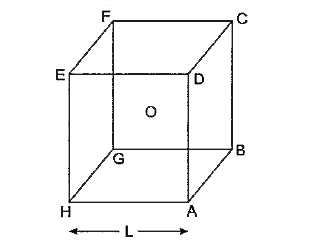
A short electric dipole (which consists of two point charges, + q and -9) is placed at the centre o and inside a large cube (ABCDEFGH) of length L, as shown in figure below. The electric flux, emanating through the cube is :

A

`q//4 pi epsi_(0)L`

B

Zero

C

`q//2pi epsi_(0)L`

D

`q//3pi epsi_(0)L`

Text Solution

Verified by Experts

The correct Answer is:

B
Promotional Banner

Similar Questions

Explore conceptually related problems

A short electric dipole (which consists of two point charges, +q and -q ) is placed at the centre O and inside a large cube (ABCDEFGH) of length L, as shown in figure. The electric flux, emanating through the cube is :

A charge q is placed at the centre of the cubical vessel (with one face a open) as shown in figure. The flux of the electric field through the complete vessel is

A point charge 'q' is placed at the centre of left circular end of a cylinder of length l=4cm and radius R=3 cm shown. Then the electric flux through the curved surface of the cylinder is

A charge Q is placed at a distance a/2 above the centre of a horizontal, spuare surface of edge a as shown in figure (30-E1). Find the flux of the electric field through the square surface.

A charge q is placed at the centre of a cube. What is the electric flux passing through the cube?

Two point charges 17.7 mu C and -17.7 mu C, separated by a very small distance, are kept inside a large hollow metallic sphere. Electric flux emanating through the sphere is:

If a point charge q is placed at the centre of a cube. What is the flux linked (a) with the cube? (b) with each face of the cube?

A point charge 'q' is placed at a distance l' (on th y -axis) vertically above the surface which lies in the xz plane as shown in the figure. The flux of electric field passing through the plate is

A charge Q is placed at a distance alpha/2 above the centre of a horizontal, square surface of edge a as shown in figure (30-E1). Find the flux of the electric field through the square surface.

A charge Q is placed at the centre of the line joining two point charges +q and +q as shown in figure. The ratio of charges Q and q is
