Home
Class 12
PHYSICS
Derive an expression for intensity of el...

Derive an expression for intensity of electric field are a point in broadside position or on an equatorial line of an electric dipole.

Text Solution

Verified by Experts
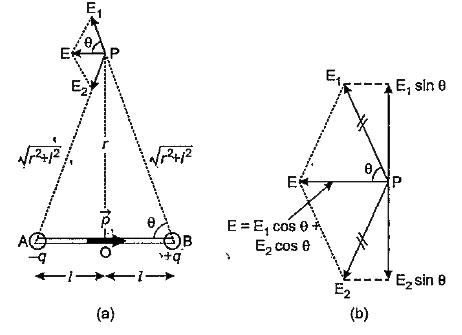
Suppose that the point P is situated on the right bisector of the dipole AB at a distance r metre from its mid-point [Fig. (a)].
Let `E_(1) and E_(2)` be the magnitudes of the intensities of the electric field at P due to the charges + q and - 2 of the dipole respectively. The distance of P from each charge is `sqrt(r^(2)+l^(2))`. Therefore,
`E_(1)=(1)/(4pi epsi_(0)) (q)/((r^(2)+l^(2)))` away from +q
and `E_(2)=(1)/(4pi epsi_(0))(q)/((r^(2)+l^(2)))`. towards -q
The magnitudes of `E_(1) and E_(2)` are equal t(but direction are different). On resolving `E_(1)and E_(2)` into two components perpendicular to AB `(E_(1) sin theta and E_(2) sin theta)` cancel other (beucse they are equal and opposite), while the components par4allel to AB `(E_(1) cos theta E_(2) cos theta)`. being in the same direction, add up [Fig.(b)]. Hence, the resultant intensity of electric field at the point P is
`E=E_(1) cos theta+E_(2) cos theta`
`=(1)/(4pi epsi_(0))(q)/((r^(2)+l^(2))) cos theta+(1)/(4pi epsi_(0))-(q)/((r^(2)+l^(2))) cos theta`
`=(1)/(4pi epsi_(0)) (q)/((r^(2)+l^(2))) 2 ocs theta`

Now, from figure (a),
`"cos" theta=(BO)/(BP)`
`=(l)/((r^(2)+l^(2))^(1//2))`
`:. E=(1)/(4pi epsi_(0))(q)/((r^(2)+l^(2)))(2l)/((r^(2)+l^(2))^(1//2))`
But 2ql=p (moment of electric dipole)
`:.E=(1)/(4pi epsi_(0))(p)/((r^(2)+l^(2))^(3//2))`
The direction of electric field E is .antiparallel to the dipole axis.
If r is very large compared to `2l (r gt gt 2l)`, then `l^(2)` may be neglected in comparison to `r^(2)`. Then, the electric field intensity at the point P due to the dipole is
`E=(1)/(4pi epsi_(0))(p)/(r^(3))` Newton//Coulomb
Promotional Banner

Similar Questions

Explore conceptually related problems

Obtain an expression for intensity of electric field in end on position, i.e., axial position of an electric dipole.

Answer the following: (a) Derive and expression for the electric field at any point on the equatorial line of an electric dipole. (b) Two identical point charges, q each kept 2m apart in air. A third point charge Q of unknown magnitude and sign is placed on the line joining the charges such that the system remains in equilibrium. Find the position and nature of Q.

Derive an expression for electric field intensity at a point due to point charge.

(i) Derive the expression for electric field at a point on the equatorial line of an electric dipole. (ii) Depiet the orientation of the dipole in (i) stable, (ii) unstable equilibrium in a uniform electric field.

Write an expression (derivation not required) for intensity of electric field in : (1) Axial position. (2) Broad side position of an electric dipole, in terms of its length (2a) dipole moment (p) and distance (r). (ii) What is the ratio of these two intensities i.e., E_(1):E_(2) , for a short electric dipole ?

(a) Draw the equipotential surfaces corresponding to a uniform electric field in the z-direction. (b) Derive an expression for the electric potential at any point along the axial line of an electric dipole

(a) Define electric dipole moment. Is it a scalar or a vector ? Derive the expression for the electric field of a dipole at a point on the equatorial plane of the dipole. (b) Draw the equipotential surfaces due to an electric dipole. Locate the points where the potential due to the dipole is zero.

Electric Field due to Dipole

The SI unit of electric field intensity is

Write an expression of magnetic flux density .B. at a point in end-on position or an axial position of a magnetic dipole. (Derivation not required.)

