Home
Class 12
PHYSICS
Define the term wavefront. Using Huygens...

Define the term wavefront. Using Huygens' wave theory, verify the laws of reflection.

Text Solution

Verified by Experts
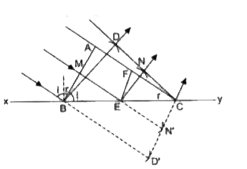
Let XY be an plane reflecting surface and AMB, the incident plane wavefront. All the particles on AB will be vibrating in phase. Let i be the angle of incidence and r the angle of reflection. In the time the disturbance at A reaches C, the secondary waves from the point B must travel a distance BD equal to AC. With the point B as centre and radius equal to AC a sphere is constructed.
From the point C, we draw tangents CD and CD.. Then, BD= BD.
In `DeltaBAC and DeltaBDC`, BC is common, BD= AC and `angleBAC= angleBDC= 90^(@)`
`therefore DeltaBAC= DeltaBDC`
and `angleABC= angleBCD`
But `angleABC=i and angleBCD=r`, i.e., i=r or the angle of incidence is equal to the angle of reflection
Promotional Banner

Similar Questions

Explore conceptually related problems

(a) Define a wavefront. Using Huygen's principle, verify the laws of reflection at a plane surface . (b) In a single slit diffraction experiment the wildth of the slit is made double the orignal width. How does this affect the size and intensity of the central diffraction band ? Explain. (c) When a tiny circular obstacle in placed in the path of light from a distance source, a bright spot is seen at the centre of the obstacle . Explain why.

Answer the following: (a) Define wavefront. Use Huygens' principle to verify the laws of refraction. (b) How is linearly polarised light obtained by the process of scattering of light? Find the Brewster angle for air-glass interface, when the refractive index of glass is 1.5 .

Define the term wave front. State Huygen's principles.

Huygen's wave theory explain the phenomena of

Huygens wave theory allows us to know

Describe an experiment to verify the laws of reflection of light.

Huygen's wave theory of light could not explain

Answer the following: (a) What is a wave front? How does it propagate? Using Huygens' principle, explain reflection of a plane wavefront from a surface and verify the laws of reflection. (b) A parallel beam of light of wavelength 500 nm falls on a narrow slit and the resulting diffraction pattern is obtained on a screen 1 m away. If the first minimum is formed at a distance of 2.5 mm from the centre of screen, find the (i) width of the slit, and (ii) distance of first secondary maximum from the centre of the screen.

