

Home
Class 12
PHYSICS
If one mole of an ideal gas at (P1, V1) ...

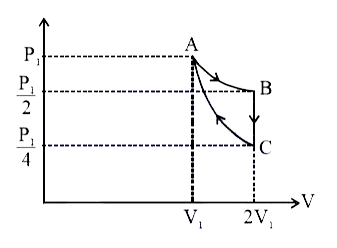
If one mole of an ideal gas at `(P_1, V_1)` is allowed to expand reversibly and isothermally (A to B) its pressure is reduced to one-half of the original pressure (see figure). This is followed by a constant volume cooling till its pressure is reduced to one-fourth of the initial value `(BrarrC)` . Then it is restored to its initial state by a reversible adiabatic compression (C to A). The net workdone by the gas is equal to :

Promotional Banner

Similar Questions

Explore conceptually related problems

A gas is suddenly compressed to one fourth of its original volume. What will be its final pressure, if its initial pressure is p

1 mole of an ideal gas is allowed to expand isothermally at 27^(@) C till its volume is tripled . If the expansion iscarried out reversibly then the DeltaS_("universe") will be?

Two moles of a certain ideal gas at 300K is cooled at constant volume so that the pressure is reduced to half the original value. Now the gas is heated at constant pressure so that its temperature becomes equal to the initial temperature. Find the total amount of heat absorbed by the gas in the process.

One mole of an ideal gas is allowed to expand isothermally and reversibly at 27^@C until its volume is tripled.Find Delta S_("system") in JK^(-1)mol^(-1)

One gram mole of an ideal gas at N.T.P is first expanded isothermally to twice the origional volume. It is then compressed at constant volume, till its pressure is raised to the original value. Calculate the total amount of work done. Given R= 8.3 mol e^(_1)K^(-1) .

If n moles of an ideal gas are expanded is isothermally and reversibly from an initial state in which it has pressure p_(1) and volume V_(1) to the final state of volume V_(2) and pressure P_(2) , then

A sample of an ideal gas in a cyclinder is compressed adiabatically to 1/3rd of its volume. Will final pressure be more or less than 3 times the initial pressure?

In the isothermal reversible compression of 52.0m mol of a perfect gas at 260 K , the volume of the gas is reduced to one - third of its initial value. Calculate w of this provess y .