

Home
Class 12
PHYSICS
A light pulley is suspended at the lower...

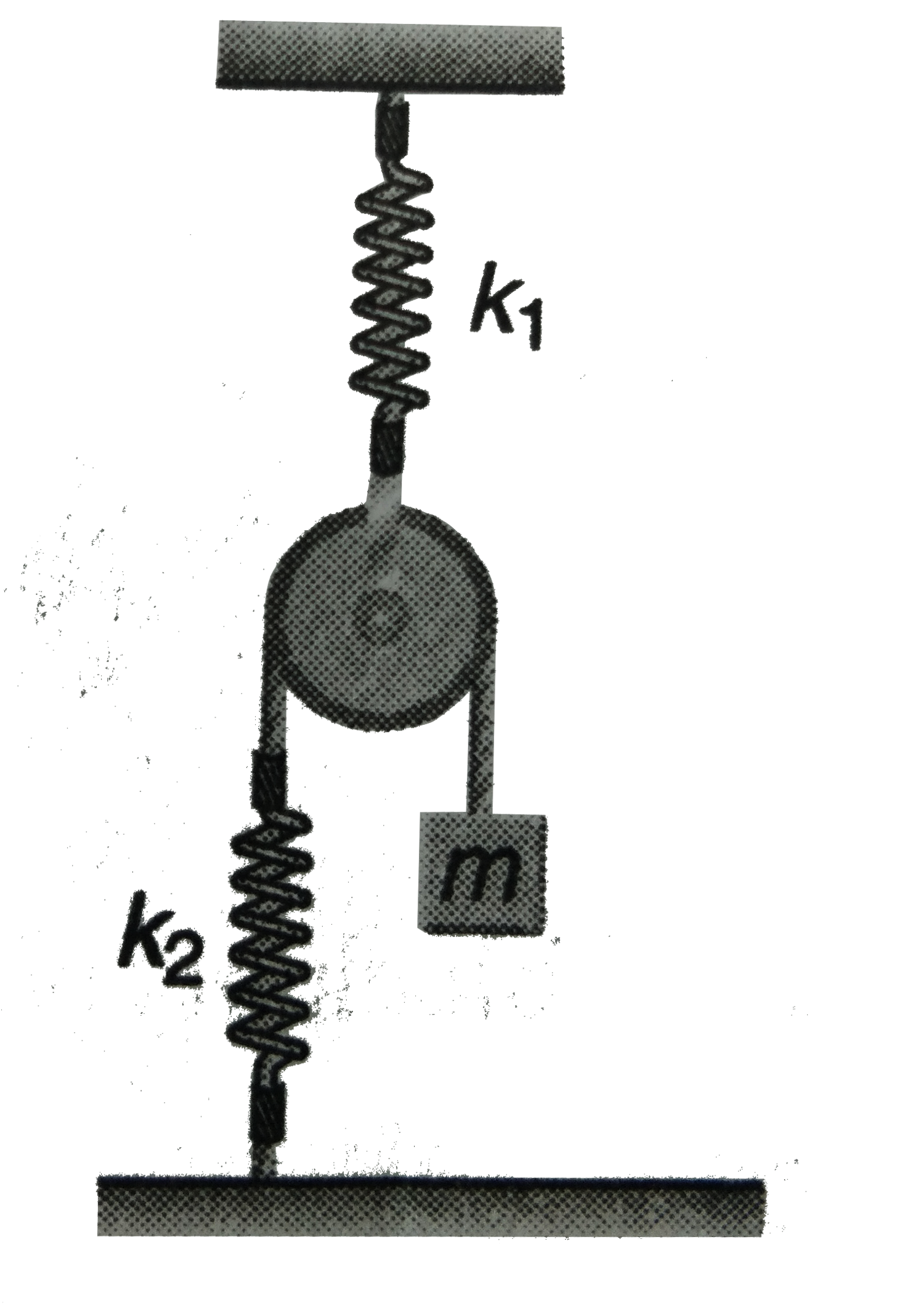
A light pulley is suspended at the lower end of a spring of constant `k_(1)`, as shown in figure. An inextensible string passes over the pulley. At one end of string a mass `m` is suspended, the other end of the string is attached to another spring of constant `k_(2)`. The other ends of both the springs are attached to rigid supports, as shown. Neglecting masses of springs and any friction, find the time period of small oscillations of mass `m` about equilibrium position.

Promotional Banner

Similar Questions

Explore conceptually related problems

A light string passes over a frictionless pulley. To one of its ends a mass of 6 kg is attached. To its other end a mass of 10 kg is attached. The tension in the thread will be

A rubber string of mass m and rigidity k is suspended at one end. Determine the elongation Delta l of the string.

Two identical springs of spring constant k are attached to a block of mass m and to fixed supports as shown in the figure. The time period of oscillation is

A block of mass m is tied to one end of a spring which passes over a smooth fixed pulley A and under a light smooth movable pulley B . The other end of the string is attached to the lower end of a spring of spring constant K_2 . Find the period of small oscillation of mass m about its equilibrium position (in second). (Take m=pi^2kg , K_2k=4K_1 , K_1=17(N)/(m). )

On a smooth inclined plane a body of mass M is attached between two springs. The other ends of the springs are fixed to firm supports. If each spring has a force constant k, the period of oscilation of the body is (assuming the spring as massless)

On a smooth inclined plane, a body of mass M is attached between two springs. The other ends of the springs are fixed to firm supports. If each spring has force constant K , the period of oscillation of the body (assuming the springs as massless) is

A bead of mass 'm' is attached to one end of a spring of natural length R & spring constant k = ((sqrt3 + 1))/(R) . The other end of the spring is fixed at point A on a smooth vertical ring of radius R as shown. The normal reaction at B just after it is released to move is