

Home
Class 8
MATHS
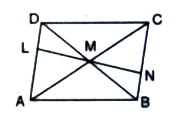
. Given: Parallelogram ABCD in which...

.
Given: Parallelogram
ABCD in which diagonals AC and CD intersect at M.
Prove: M is mid-point of LN.

Promotional Banner

Topper's Solved these Questions

  • SPECIAL TYPES OF QUADRILATERALS

    ICSE|Exercise EXERCISE|22 Videos
  • SETS

    ICSE|Exercise EXERCISE 6( E)|11 Videos
  • SQUARES AND SQUARE ROOTS

    ICSE|Exercise Exercise3 (C )|16 Videos

Similar Questions

Explore conceptually related problems

In parallelogram ABCD, E is the mid-point of AB and AP is parallel to EC which meets DC at point O and BC produced at P. Prove that: O is mid-point of AP.

In a trapezium ABCD, side AB is parallel to side DC, and the diagonals AC and BD intersect each other at point P. Prove that : DeltaAPB is similar to DeltaCPD .

In parallelogram ABCD, the bisectors of adjacent angles A and D intersect each other at point P. prove that angleAPD=90^(@) .

In the following figure, M is mid-point of BC of a parallelogram ABCD. DM intersects the diagonal AC at P and AB produced at E. Prove that : PE = 2 PD .

Construct a parallelogram ABCD in which AC = 6.5 cm , BD = 7 cm , diagonals AC and BD intersects each other at angle 45 ^(@)

The adjoining figure shows a parallelogram ABCD in which P is mid-point of AB and Q is mid-point of CD. Prove that AE=EF=FC .

The given figure shows a parallelogram ABCD whose diagonals intersect each other at point O. if OB=6 cm and AC is 6 cm more than BD, find OC.

In trapezium ABCD, side AB is parallel to side DC. Diagonals AC and BD intersect at point P. Prove that triangles APD and BPC are equal in area.

If the quadrilateral formed by joining the mid points of the adjacent sides of quadrilateral ABCD is a rectangle, show that the diagonals AC and BD intersect at right angle.

ABC is a triangle right angled at C and M is mid-point of hypotenuse AB. Line drawn through M and parallel to BC intersects AC at D. Show that: MD is mid-point of AC.

ICSE-SPECIAL TYPES OF QUADRILATERALS-EXERCISE
  1. In rhombus ABCD: (i) if angleA=74^(@), find angleB and angleC. (ii...

    Text Solution

    |

  2. In square PQRS: (i) if PQ=3x-7 and QR=x+3, find PS. (ii) if PR=5x ...

    Text Solution

    |

  3. ABCD is a rectangle. If angleBPC=124^(@). Calculate: (i) angleBA...

    Text Solution

    |

  4. ABCD is a rhombus. If angleBAC=38^(@), find: (i) angleACB (ii) ang...

    Text Solution

    |

  5. ABCD is a rhombus. If angleBCA=35^(@), and angleADC.

    Text Solution

    |

  6. PQRS is a parallelogram whose diagonals intersect at M. if anglePMS=...

    Text Solution

    |

  7. . Given: Parallelogram ABCD in which diagonals AC and CD intersect...

    Text Solution

    |

  8. In an isosceles-trapezium, show that the opposite angles are supplemen...

    Text Solution

    |

  9. ABCD is a parallelogram. What kind of quadrilateral is it if: (i) AC...

    Text Solution

    |

  10. Prove that the diagonals of a parallelogram bisect each other.

    Text Solution

    |

  11. If the diagonals of a parallelogram are of equal lengths, the parallel...

    Text Solution

    |

  12. In parallelogram ABCD, E is the mid-point of AD and F is the mid-point...

    Text Solution

    |

  13. In parallelogram ABCD, E is the mid-point of side AB and CE bisect ang...

    Text Solution

    |

  14. In the alongside diagram, the bisectors of interior angles of the para...

    Text Solution

    |

  15. In parallelogram ABCD, X and Y are mid-points of opposite sides AB and...

    Text Solution

    |

  16. The given figure shows parallelogram ABCD. Points M and N lie in diago...

    Text Solution

    |

  17. . The given figure shows a rhombus ABCD in which angle BCD=80^(@). F...

    Text Solution

    |

  18. Use the information given in the following diagram to find the values ...

    Text Solution

    |

  19. The following figure is a rectangle in which x:y=3:7, find the values ...

    Text Solution

    |

  20. In the given figure, AB////EC,AB=AC and AE bisects angleDAC. Prove tha...

    Text Solution

    |