

Home
Class 10
CHEMISTRY
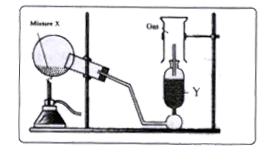
The diagram shows an experimental set up...

The diagram shows an experimental set up for the laboratory preparation of a pungent smelling gas. The gas is alkaline in nature.

Write the balanced equation for the above preparation.

Promotional Banner

Topper's Solved these Questions

  • SELF ASSESSMENT PAPER 3

    ICSE|Exercise SECTION-II|40 Videos
  • SELF ASSESSMENT PAPER 2

    ICSE|Exercise SECTION-II|45 Videos
  • SELF ASSESSMENT PAPER 4

    ICSE|Exercise Section -II|42 Videos

Similar Questions

Explore conceptually related problems

The diagram shows an experimental set up for the laboratory preparation of a pungent smelling gas. The gas is alkaline in nature. Name the drying agent used.

The diagram shows an experimental set up for the laboratory preparation of a pungent smelling gas. The gas is alkaline in nature. Name the gas collected in the jar.

The diagram shows an experimental set up for the laboratory preparation of a pungent smelling gas. The gas is alkaline in nature. Name the gas collected in the jar.

The diagram shows an experimental set up for the laboratory preparation of a pungent smelling gas. The gas is alkaline in nature. How is the gas being collected ?

The diagram shows an experimental set up for the laboratory preparation of a pungent smelling gas. The gas is alkaline in nature. Name the gas collected in the jar.

The diagram shows an experimental set up for the laboratory preparation of a pungent smelling gas. The gas is alkaline in nature. How will you find that the jar is full of gas?

The diagram shows an experimental set up for the laboratory preparation of a pungent smelling gas. The gas is alkaline in nature. How will you find that the jar is full of gas?

Write balanced equation for the preparation of urotropine.

The diagram shows an apparatus for the laboratory preparation of hydrogen chloride. Identify A and B.

In the laboratory preparation of carbon dioxide by action of a dilute acid on a metallic carbonate give A balanced equation for the preparation

ICSE-SELF ASSESSMENT PAPER 3 -SECTION-II
  1. Select the correct method from: Simple displacement ,Decomposition by ...

    Text Solution

    |

  2. The diagram shows an experimental set up for the laboratory preparatio...

    Text Solution

    |

  3. The diagram shows an experimental set up for the laboratory preparatio...

    Text Solution

    |

  4. The diagram shows an experimental set up for the laboratory preparatio...

    Text Solution

    |

  5. The diagram shows an experimental set up for the laboratory preparatio...

    Text Solution

    |

  6. The diagram shows an experimental set up for the laboratory preparatio...

    Text Solution

    |

  7. A compound has the following percentage composition by mass : Carbon ...

    Text Solution

    |

  8. The following questions related to the extraction of aluminium by elec...

    Text Solution

    |

  9. The following questions related to the extraction of aluminium by elec...

    Text Solution

    |

  10. The following questions related to the extraction of aluminium by elec...

    Text Solution

    |

  11. Arrange the following as per the instructions given in the brackets: ...

    Text Solution

    |

  12. Arrange the following as per the instructions given in the brackets :...

    Text Solution

    |

  13. Arrange the following as per the instructions given in the brackets :...

    Text Solution

    |

  14. How does ammonium hydroxide help in distinguish between: Iron (II) ...

    Text Solution

    |

  15. How does ammonium hydroxide help in distinguish between: Zinc nitrat...

    Text Solution

    |

  16. The figure given alongside illustrates the apparatus used in the labor...

    Text Solution

    |

  17. Write an equation to show how nitric acid undergoes decomposition.

    Text Solution

    |

  18. The figure given below illustrates the apparatus used in the laborator...

    Text Solution

    |

  19. When moist chlorine reacts with hydrogen sulphide, name the two produc...

    Text Solution

    |

  20. Name an organic compound used as a thermometric liquid.

    Text Solution

    |