Home
Class 10
CHEMISTRY
The figure given alongside illustrates t...

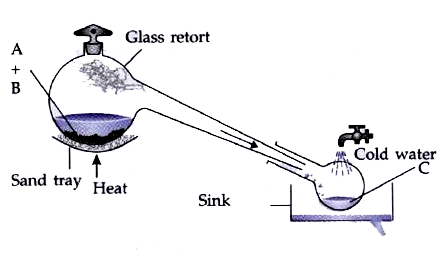
The figure given alongside illustrates the apparatus used in the laboratory preparation B of nitric acid.

Name A (a liquid), B (a solid) and C (a liquid) (Do not give the formulae) 

Text Solution

Verified by Experts

(A) An acid which has high affinity for water.
(B) A metallic nitrate and the atomic number of metal is 19
Promotional Banner

Topper's Solved these Questions

  • SELF ASSESSMENT PAPER 3

    ICSE|Exercise SECTION-II|40 Videos
  • SELF ASSESSMENT PAPER 2

    ICSE|Exercise SECTION-II|45 Videos
  • SELF ASSESSMENT PAPER 4

    ICSE|Exercise Section -II|42 Videos

Similar Questions

Explore conceptually related problems

The figure given below illustrates the apparatus used in the laboratory preparation of nitric acid. Name A (a liquid), B(a solid) and C(liquid). (Do not give the formulae)

All glass apparatus is used in the laboratory preparation of nitric acid. Explain ?

Explain the following : All glass apparatus is used in the laboratory preparation of nitric acid .

What is the special feature of the apparatus that is used in the laboratory preparation of nitric acid?

The figure given below illustrates the apparatus used in the laboratory preparation of nitric acid. Complete the following: _____ is oxidised by nitric acid.

The figure given alongside illustrates the apparatus used in the laboratory preparation B of nitric acid. Write the equation for the reaction in which copper is oxidized by concentrated nitric acid.

The figure given below illustrates the apparatus used in the laboratory preparation of nitric acid. Write an equation to show how nitric acid undergoes decomposition.

The figure given below illustrates the apparatus used in the laboratory preparation of nitric acid. Write the equation for the reaction in which copper is oxidised by concentrated nitric acid.

With respect to the laboratory preparation of hydrochloric acid answer the following question : Name the substance A and give its use .

Give reasons for the following - pertaining to the above laboratory preparation of nitric acid (i) concentrated hydrochloric acid is not used as a reactant in the laboratory preparation the complete apparatus in the laboratory preparation does not contain parts made of rubber or cork. , (iii) the reaction temperature is maintained below 200^(@)C (iv) at high temperatures the sodium sulphate or potasium sulphate formed , forms a crust and sticks to the glass apparatus .

ICSE-SELF ASSESSMENT PAPER 3 -SECTION-II
  1. The following questions related to the extraction of aluminium by elec...

    Text Solution

    |

  2. The following questions related to the extraction of aluminium by elec...

    Text Solution

    |

  3. The following questions related to the extraction of aluminium by elec...

    Text Solution

    |

  4. Arrange the following as per the instructions given in the brackets: ...

    Text Solution

    |

  5. Arrange the following as per the instructions given in the brackets :...

    Text Solution

    |

  6. Arrange the following as per the instructions given in the brackets :...

    Text Solution

    |

  7. How does ammonium hydroxide help in distinguish between: Iron (II) ...

    Text Solution

    |

  8. How does ammonium hydroxide help in distinguish between: Zinc nitrat...

    Text Solution

    |

  9. The figure given alongside illustrates the apparatus used in the labor...

    Text Solution

    |

  10. Write an equation to show how nitric acid undergoes decomposition.

    Text Solution

    |

  11. The figure given below illustrates the apparatus used in the laborator...

    Text Solution

    |

  12. When moist chlorine reacts with hydrogen sulphide, name the two produc...

    Text Solution

    |

  13. Name an organic compound used as a thermometric liquid.

    Text Solution

    |

  14. Why is hydrogen chloride not collected over water ?

    Text Solution

    |

  15. Name the chemical in which gold can be dissolved.

    Text Solution

    |

  16. Name : a yellow monoxide that dissolves in hot and concentrated caus...

    Text Solution

    |

  17. Match the following columns

    Text Solution

    |

  18. Complete the following chemical equations : Al(4)C(3)+12H(2)O to

    Text Solution

    |

  19. Complete the following chemical equations : CaC(2)+2H(2)O overset(2...

    Text Solution

    |

  20. Complete the following chemical equations : C(2)H(5)Br overset(KOH)...

    Text Solution

    |
