

Home
Class 10
CHEMISTRY
By drawing an electron dot diagram, show...

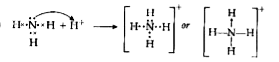
By drawing an electron dot diagram, show the lone pair effect leading to the formation of ammonium ion from ammonia gas and hydrogen ion.

Text Solution

Verified by Experts


`NH_3` has one lone pair of electrons, which is donated to hydrogen atom forming a co-ordinate bond. The arrow represents co-ordinate bond and the arrow points from donor to acceptor atom.
Promotional Banner

Topper's Solved these Questions

  • SAMPLE QUESTION PAPER 03

    ICSE|Exercise SECTION II|47 Videos
  • SAMPLE QUESTION PAPER 02

    ICSE|Exercise SECTION ll|44 Videos
  • SAMPLE QUESTION PAPER 5

    ICSE|Exercise Section II|35 Videos

Similar Questions

Explore conceptually related problems

Draw an electron dot diagram: showing the lone pair effect for information of - NH_(4)^(1+) ion from NH_(3) gas & H^(1+) ion.

By drawing an electron dot notation show the formation of ammonium ion .

By drawing an electron dot diagram show the formation of Ammonium Ion [Atomic No. : N = 7 and H = 1]

Draw the electron dot diagram of formation of ammonium ion from ammonia molecule.

Draw an electron dot diagram of a hydronium ion and label the lone pair of electron.

What feature of ammonia molecule leads to the formation of ammonium ion when ammonia dissolves in water ?

Oxygen atom in water has two 'lone pair of electrons'. Explain the meaning of the term in italics. With the help of an electron dot diagram show the formation of hydronium ion and ammonium ion from a water molecule and an ammonia molecule respectively.

Draw an electron dot diagram to show the formation of ammonium ion [N = 7, H = 1]

Draw an electron dot diagram to show the structure of hydronium ion. State the type of bonding present in it.

Explain diagrammatically the lone pair effect of [a] The nitrogen atom of the ammonia molecule leading to the formation of ammonium ions [NH_(4)]^(+) [b] The oxygen atom of the H_(2)O molecule leading to formation of hydronium [H_(3)O^(+)] & hydroxyl ions [OH]^(-)

ICSE-SAMPLE QUESTION PAPER 03-SECTION II
  1. Arrange the following as per the instructions given in the brackets :...

    Text Solution

    |

  2. Arrange the following as per instructions given in the brackets: Cl,...

    Text Solution

    |

  3. By drawing an electron dot diagram, show the lone pair effect leading...

    Text Solution

    |

  4. Identify the acid which matches the following description : Give bal...

    Text Solution

    |

  5. Name a yellow monoxide that dissolves in hot and concentrated alkali. ...

    Text Solution

    |

  6. Study the figure given below and answer the questions that follow : ...

    Text Solution

    |

  7. Study the figure given below and answer the questions that follow : ...

    Text Solution

    |

  8. Study the figure given below and answer the questions that follow : ...

    Text Solution

    |

  9. Why is (a) concentrated sulphuric acid kept in air tight bottles ?

    Text Solution

    |

  10. Why is H2SO4 not a drying agent for H2S ?

    Text Solution

    |

  11. Copy and Complete the following table which refers to two practical ap...

    Text Solution

    |

  12. The questions below are related to the manufacture of ammonia. Name ...

    Text Solution

    |

  13. The questions below are related to the manufacture of ammonia. In wh...

    Text Solution

    |

  14. The questions below are related to the manufacture of ammonia. Name ...

    Text Solution

    |

  15. The questions below are related to the manufacture of ammonia. Give ...

    Text Solution

    |

  16. Consider the following reaction and based on the reaction answer the q...

    Text Solution

    |

  17. Consider the following reaction and based on the reaction answer the q...

    Text Solution

    |

  18. Consider the following reaction and based on the reaction answer the q...

    Text Solution

    |

  19. Consider the following reaction and based on the reaction answer the q...

    Text Solution

    |

  20. Correct the following if required: HNO3 is a strong reducing agent.

    Text Solution

    |