Home
Class 10
BIOLOGY
A candidate in order to study the proces...

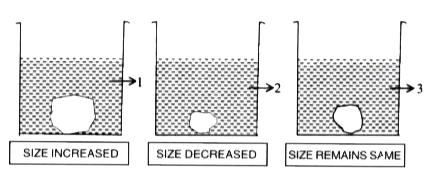
A candidate in order to study the process of osmosis has taken 3 potato cubes and put them in 3 different beakers containing 3 different solutions. After 24 hours, in the first beaker, the potato cube increased in size, in the second beaker, the potato cube decreased in size and in the third beaker there was no change in the size of the potato cube. The following diagram shows the result of the same experiment :

Give the technical terms of the solutions used in beakers, 1 , 2 and 3 .

Text Solution

Verified by Experts

(i) The technical terms of the solution used in beakers (a), (b) and (c) are
(a) Hypotonic solution
(b) Hypertonic solution
(c) Isotonic solution
(ii) In beaker c, there is no difference in concentration of solution and the concentration of cell sap. So there is no movement of water molecules / No osmosis.
(iii) Concentrated cell sap.
(iv) It is the movement of water / solvent molecules from the region of it.s higher concentration to the region of lower concentration across a semipermeable membrane.
(v) Cell wall - Freely permeable. Cell membrane - Selectively permeable.
Promotional Banner

Topper's Solved these Questions

  • SAMPLE QUESTION PAPER 3

    ICSE|Exercise SECTION-II|24 Videos
  • SAMPLE QUESTION PAPER 2

    ICSE|Exercise SECTION -II|65 Videos
  • SAMPLE QUESTION PAPER 4

    ICSE|Exercise SECTION-II|12 Videos

Similar Questions

Explore conceptually related problems

A candidate in order to study the process of osmosis has taken 3 potato cubes and put them in 3 different beakers containing 3 different solutions. After 24 hours, in the first beaker, the potato cube increased in size, in the second beaker, the potato cube decreased in size and in the third beaker there was no change in the size of the potato cube. The following diagram shows the result of the same experiment : What is osmosis ?

A candidate in order to study the process of osmosis has taken 3 potato cubes and put them in 3 different beakers containing 3 different solutions. After 24 hours, in the first beaker, the potato cube increased in size, in the second beaker, the potato cube decreased in size and in the third beaker there was no change in the size of the potato cube. The following diagram shows the result of the same experiment : In beaker 3, the size of the potato cube remains the same. Explain the reason in brief.

A candidate in order to study the process of osmosis has taken 3 potato cubes and put them in 3 different beakers containing 3 different solutions. After 24 hours, in the first beaker, the potato cube increased in size, in the second beaker, the potato cube decreased in size and in the third beaker there was no change in the size of the potato cube. The following diagram shows the result of the same experiment : Write the specific feature of the cell sap of root hairs which helps in absorption of water.

A candidate in order to study the process of osmosis has taken 3 potato cubes and put them in 3 different beakers containing 3 different solutions. After 24 hours, in the first beaker, the potato cube increased in size, in the second beaker, the potato cube decreased in size and in the third beaker there was no change in the size of the potato cube. The following diagram shows the result of the same experiment : How does a cell wall and a cell membrane differ in their permeability?

Eyes in potato tubers are

Eye of potato is

The 'eyes' of the potato tuber represent

The 'Eyes' of the potato tuber are

A rat feeding on potato tuber is a

The "Eyes" of the potato tuber are

ICSE-SAMPLE QUESTION PAPER 3-SECTION-II
  1. Explain the following term : Turgor pressure.

    Text Solution

    |

  2. Explain the term root pressure.

    Text Solution

    |

  3. State whether true or false. Rewrite the false statements in their cor...

    Text Solution

    |

  4. Define the following Photophosphorylation.

    Text Solution

    |

  5. A candidate in order to study the process of osmosis has taken 3 potat...

    Text Solution

    |

  6. Name the following: The respiratory pigment present in erythrocytes...

    Text Solution

    |

  7. The phase of cardiac cycle in which the auricles contract.

    Text Solution

    |

  8. The blood vessel which carries oxygenated blood to the liver.

    Text Solution

    |

  9. Name the following: The vein that carries oxygenated blood.

    Text Solution

    |

  10. Covering of the lungs is called

    Text Solution

    |

  11. The diagram given below shows a section of a human kidney. Study the d...

    Text Solution

    |

  12. Match the items given in Column A with the most appropriate ones in Co...

    Text Solution

    |

  13. The diagram given below is an experiment conducted to study a factor n...

    Text Solution

    |

  14. What do the following abbreviations stand for : (i) AMP (ii) ADP (i...

    Text Solution

    |

  15. The following diagram represents the human brain as seen in an externa...

    Text Solution

    |

  16. Account for the following briefly : Herbaceous plants growing in we...

    Text Solution

    |

  17. Jamming of wooden doors and windows takes place during rainy season. G...

    Text Solution

    |

  18. Comment upon the following : The leaves of plants roll up on a brigh...

    Text Solution

    |

  19. Give reason for the following Animals owe their existence to chlorop...

    Text Solution

    |

  20. Choose the correct answer from each of the four options given below: ...

    Text Solution

    |
