Home
Class 10
BIOLOGY
State one difference in each of the foll...

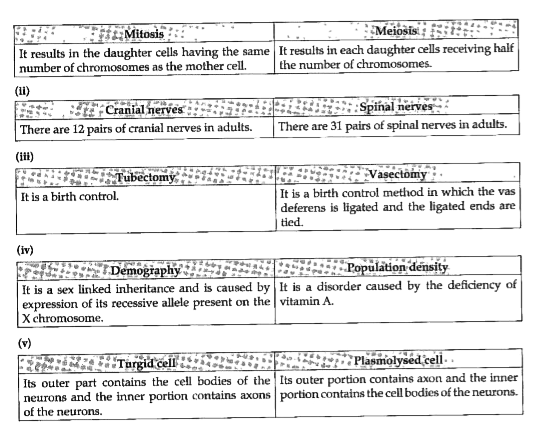
State one difference in each of the following with respect to the aspect stated within the brackets.
(i) Mitosis and meiosis (chromosome number)
(ii) Cranial and spinal nerves (total number in adults)
(iii) Tubectomy and vasectomy (parts operated)
(iv) Colourblindness and night blindness (caused due to)
(v) Cerebrum and spinal cord (arrangement of neurons)

Text Solution

Verified by Experts
Promotional Banner

Topper's Solved these Questions

  • SAMPLE QUESTION PAPER -5

    ICSE|Exercise SECTION-II|24 Videos
  • SAMPLE PAPER 3

    ICSE|Exercise SECTION - III|10 Videos
  • SAMPLE QUESTION PAPER 1

    ICSE|Exercise SECTION II|60 Videos

Similar Questions

Explore conceptually related problems

State whether each of the following set is finite or infinite:(i) The set of lines which are parallel to the x–axis(ii) The set of letters in the English alphabet(iii) The set of numbers which are multiple of 5(iv) The set of animals living on the earth(v) The set of circles passing through the origin (0, 0)

State whether each of the following set is finite or infinite : (i) The set of lines which are parallel to the x-axis (ii) The set of letters in the English alphabet (iii) The set of number which are multiple of 5 (iv) The set of animals living on the earth (v) The set of circles passing through the origin (0,0).

In each of the following state if the statement is true (T) or false (F): (i) The quotient of two integers is always an integer. (ii) Every integer is a rational number. (iii) Every rational number is an integer. (iv) Every fraction is a rational number. (v) Every rational number is a fraction. (vi) If a/b is a rational number and m any integer, then a/b=(axxm)/(bxxm) (vii) Two rational numbers with different numerators cannot be equal. (viii) 8 can be written as a rational number with any integer as denominator. (ix) 8 can be written as a rational number with any integer as numerator. (x) 2/3 is equal to 4/6dot

The diagram given below is a representation of a phenomenon pertaining to the nervous system. Study the diagram and answer the following questions: (i) Name the phenomenon that is being depicted. (ii) Give the technical term for the point of contact between the two nerve cells. (iii) Name the parts A, B, C and D. (iv) Write the functions of parts E and F. (v) How does the arrangement of neurons in the spinal cord differ from that of the brain.

Consider the following statements and select the option stating which ones are true (T) and which ones are false (F) (i) There are many side effects of tubectomy and vasectomy (ii) Purpose of tubectomy is to prevent egg formation (iii) Contraceptive oral pills help in birth control by preventing ovulation (iv) Gential warts is a sexually transmitted disease caused by herpes virus (v) In India, there is rapid decline in infant mortality rate adn MMR.

In each of the following, there are three positive numbers. State if these numbers could possibly be the lengths of the sides of a triangle: (i) 5,7,9 (ii) 2, 10 , 15 (iii) 3,4,5 (iv) 2,5,7 (v) 5,8, 20

State the number of significant figures in each of the following: (i) 136.7 m (ii) 105.67 kg (iii) 3.4 xx 10^(6)s (iv) 0.0078 km (v) 0.00650 xx 10^(6) m

State true or false statements. Correct each false statements to make it true. (i) Within a species, genetic diversity occurs in the differences of alleles, entire genes and chromosomal structures. (ii) 1000 varieties of rice occur in India due to genetic variation. (iii) Ecosystem diversity is high in Norway because of the occurrence of a large number of ecosystems.

Given below are diagrams showing the different stages in the process of fertilisation of an egg in the human female reproductive tract. Study the diagrams and answer the questions (i) Arrange the letters given below each diagram in a logical sequence to show the correct order in the process of fertilisation. (ii) Where does fertilisation normally take place? What is 'Implantation' that follows fertilisation ? (iii) Mention the chromosome number of the egg and zygote in humans. (iv) Explain the term 'Gestation'. How long does Gestation last in humans ? (v) Draw a neat, labelled diagram of a mature human sperm.

Select the total number of false statement from the following (i) The globular head is an active ATPase enzyme and has binding sites for ATP and active sites for Myosin. (ii) Each Myosin filament is also a polymerized protein (iii) Many monomeric proteins celled Meromyosins constitute one thick filament. (iv) Each meromyosin has two important parts, a globular head with a short arm and a tail, the former being called the heavy meromyosin (HMA) and the latter, the light meromysin (LMN). (v) The HMM component, i.e., the head and short arm projects outwards at regular distance and angle from each other from the surface of a polymerized myosin filament and is known as cross arm (a) 5 (b) 4 (c) 2 (d)1

ICSE-SAMPLE QUESTION PAPER -5-SECTION-II
  1. State one difference in each of the following with respect to the aspe...

    Text Solution

    |

  2. The diagram given below represents an organ system in the human body. ...

    Text Solution

    |

  3. Give biological reason for the following : On sprinkling common salt...

    Text Solution

    |

  4. Comment upon the following : Wilted lettuce becomes crisp/firm when ...

    Text Solution

    |

  5. Gametes have a haploid number of chromosomes.

    Text Solution

    |

  6. Account for the following briefly : Herbaceous plants growing in wel...

    Text Solution

    |

  7. Give reasons : Plants begin to die when excess of soluble fertilizer...

    Text Solution

    |

  8. Given below is an experimental set-up to study a particular process: ...

    Text Solution

    |

  9. Match the items given in Column A with the most appropriate ones in Co...

    Text Solution

    |

  10. Study the diagrams given below and answer the questions tht follow: ...

    Text Solution

    |

  11. The following paragraph is related to absorption of water from the soi...

    Text Solution

    |

  12. The figure given below represents an experiment to demonstrate a parti...

    Text Solution

    |

  13. Match the items givenn in Column A with the most appropriate ones in C...

    Text Solution

    |

  14. Given alongside is a diagram of the human heart showing its internal s...

    Text Solution

    |

  15. Differentiate between the following pair on the basis of what is menti...

    Text Solution

    |

  16. Differentiate between the following pair on the basis of what is menti...

    Text Solution

    |

  17. Differentiate between : Testosterone and Oestrogen (organ which s...

    Text Solution

    |

  18. Differentiate between the following pair on the basis of what is menti...

    Text Solution

    |

  19. Differentiate between the following pairs on the basis of what is ment...

    Text Solution

    |

  20. Study the diagram given below which represents a stage during the mito...

    Text Solution

    |

  21. How does the arrangement of neurons in the spinal cord differ from tha...

    Text Solution

    |

