Home
Class 10
BIOLOGY
The given diagram represents a layer of ...

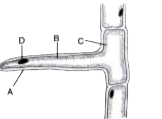
The given diagram represents a layer of epidermal cells showing a fully-grown root hair. Study the diagram and answer the questions that follow :

The root hair cell is in a turgid state. Name and explain the process that caused this state .

Text Solution

Verified by Experts

The process is called endosmosis and is defined as the movement of solvent (water) from outside to inside of the cell.
Promotional Banner

Topper's Solved these Questions

  • SAMPLE PAPER 2011

    ICSE|Exercise SECTION-II|52 Videos
  • SAMPLE PAPER 2 (BIOLOGY)

    ICSE|Exercise SECTION - III |10 Videos
  • SAMPLE PAPER 2012

    ICSE|Exercise SECTION-II|57 Videos

Similar Questions

Explore conceptually related problems

The given diagram represents a layer of epidermal cells showing a fully-grown root hair. Study the diagram and answer the questions that follow : Name the parts labelled A, B, C and D.

The given diagram represents a layer of epidermal cells showing a fully-grown root hair. Study the diagram and answer the questions that follow : Mention one distinct difference between the parts labelled A and B.

The given diagram represents a layer of epidermal cells showing a fully-grown root hair. Study the diagram and answer the questions that follow : Draw a diagram of the above root hair cell as it would appear when a concentrated solution of fertilizers is added near it.

Study the diagram and answer the questions that follow : Name the rounded cells filled with fat.

Study the diagram and answer the questions that follow: State the composition of part .6..

Study the diagram and answer the questions that follow : Name the cells found on the outer region of this part.

Study the diagram given below and then answer the question that follow : Identify the cell.

Study the diagram given below and answer the questions that follow : Name the process being studied in the experiment.

ICSE-SAMPLE PAPER 2011-SECTION-II
  1. The diagram given below represents two reproductive cells A and B. Stu...

    Text Solution

    |

  2. The given diagram represents a layer of epidermal cells showing a full...

    Text Solution

    |

  3. The given diagram represents a layer of epidermal cells showing a full...

    Text Solution

    |

  4. The given diagram represents a layer of epidermal cells showing a full...

    Text Solution

    |

  5. The given diagram represents a layer of epidermal cells showing a full...

    Text Solution

    |

  6. The diagram given below represents a stage during cell division. Study...

    Text Solution

    |

  7. The diagram given below represents a stage during cell division. Study...

    Text Solution

    |

  8. The diagram given below represents a stage during cell division. Study...

    Text Solution

    |

  9. The diagram given below represents a stage during cell division. Study...

    Text Solution

    |

  10. Study the diagram given below and answer the questions that follow : ...

    Text Solution

    |

  11. Study the diagram given below and answer the questions that follow : ...

    Text Solution

    |

  12. Study the diagram given below and answer the questions that follow : ...

    Text Solution

    |

  13. Study the diagram given below and answer the questions that follow : ...

    Text Solution

    |

  14. Study the diagram given below and answer the questions that follow : ...

    Text Solution

    |

  15. Given below is a table comparing the effects of sympathetic and parasy...

    Text Solution

    |

  16. List four major activities of the Red Cross.

    Text Solution

    |

  17. Define antiseptics and disinfectants. How do these differ? Give one ex...

    Text Solution

    |

  18. Write down the difference between the following pairs as indicated wit...

    Text Solution

    |

  19. Write down the difference between the following pairs as indicated wit...

    Text Solution

    |

  20. Expand the abbreviation : NADP

    Text Solution

    |
