

Home
Class 10
BIOLOGY
The diagram given below is that of a dev...

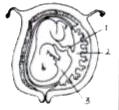
The diagram given below is that of a developing human foetus. Study the diagram and then answer the questions that follow :

(i) Label the parts numbered 1 to 3 in the diagram.
(ii) Mention any two functions of the part labelled 2 in the diagram.
(iii) Explain the significance of the part numbered 3 in the diagram.
(iv) Define the term 'Gestation'. What is the normal gestational period of the developing human embryo?
(v) Mention the sex chromosomes in a male and female embryo.

Promotional Banner

Topper's Solved these Questions

  • SAMPLE PAPER 2016

    ICSE|Exercise SECTION-I (CHOOSE THE CORRECT ANSWER)|5 Videos
  • SAMPLE PAPER 2015

    ICSE|Exercise SECTION-II|63 Videos
  • SAMPLE PAPER 2017

    ICSE|Exercise SECTION-II|65 Videos

Similar Questions

Explore conceptually related problems

Study the diagram and answer the questions that follow : Label the parts numbered as 1 and 2.

The diagram given below shows the male urinogenital system of a human being. Study the diagram and answer the questions that follow : Label the parts numbered 1 to 8.

Study the diagram and answer the questions that follow : Label the parts 1-5

Study the diagram and answer the questions that follow : Label the parts 1 - 4

The diagram given below is that of a developing human foetus. Study the diagram and then answer the questions that follow : Mention the sex chromosomes in a male and female embryo.

Study the diagram given below and answer the questions that follow: Label the parts numbered as .1. and .2..

Study the diagram given below and answer the questions that follow : Label the parts numbered as .1. and .2..

Study the diagram given below and answer the questions that follow : Label the parts numbered 1 and 2.

Study the diagram given below and answer the questions that follow : Label the parts numbered 1 and 2.

Study the diagram and answer the questions that follow : Label the parts 1 - 4.

ICSE-SAMPLE PAPER 2016-SECTION-II
  1. Give scientific reasons for the following statements: Loss of nucleu...

    Text Solution

    |

  2. Explain briefly : Blood flows in arteries in spurts and is under pr...

    Text Solution

    |

  3. The diagram given below is that of a developing human foetus. Study th...

    Text Solution

    |

  4. The diagram given below is that of a developing human foetus. Study th...

    Text Solution

    |

  5. The diagram given below is that of a developing human foetus. Study th...

    Text Solution

    |

  6. The diagram given below is that of a developing human foetus. Study th...

    Text Solution

    |

  7. The diagram given below is that of a developing human foetus. Study th...

    Text Solution

    |

  8. The following diagram demonstrates a physiological process taking plac...

    Text Solution

    |

  9. The following diagram demonstrates a physiological process taking plac...

    Text Solution

    |

  10. The following diagram demonstrates a physiological process taking plac...

    Text Solution

    |

  11. The following diagram demonstrates a physiological process taking plac...

    Text Solution

    |

  12. The following diagram demonstrates a physiological process taking plac...

    Text Solution

    |

  13. A homozygous tall plant (T) bearing red coloured ( R ) flowers is cro...

    Text Solution

    |

  14. A homozygous tall plant (T) bearing red coloured ( R ) flowers is cro...

    Text Solution

    |

  15. A homozygous tall plant (T) bearing red coloured ( R ) flowers is cro...

    Text Solution

    |

  16. A homozygous tall plant (T) bearing red coloured ( R ) flowers is cro...

    Text Solution

    |

  17. A homozygous tall plant (T) bearing red coloured ( R ) flowers is cro...

    Text Solution

    |

  18. Explain the term Reflex action.

    Text Solution

    |

  19. With reference to the functioning of the eye, answer the questions tha...

    Text Solution

    |

  20. Briefly explain the following: Photophosphorylation

    Text Solution

    |