Home
Class 11
CHEMISTRY
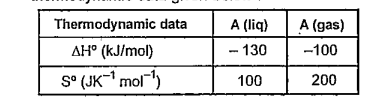
Assuming DeltaH^@ and S^@ do not change ...

Assuming `DeltaH^@` and `S^@` do not change with temperature, calculate the boiling point of liquid ‘A’ using the thermodynamic data given below :

A

300 K

B

130 K

C

150 K

D

50 K

Text Solution

Verified by Experts

The correct Answer is:

A
Promotional Banner

Topper's Solved these Questions

  • STATES OF MATTER (GASES & LIQUIDS)

    PATHFINDER|Exercise QUESTION BANK|280 Videos

Similar Questions

Explore conceptually related problems

What do you mean by the normal boiling point of a liquid?

Show graphically how the vapour pressures of a solvent and a solution of a non-volatile solute in it change with temperature. Show on the graph boiling point of the solvent and the solution. Which is higher and why?

Explain why an organic liquid vaporises at a temperature below its boiling point in its steam distillation?

Explain, why an organic liquid vaporise at a temprature below its boiling point in its steam distillation?

State whether True or False:- Temperature changes when a liquid boils.

This question has statement I and II. Of the four choices given after the statements, choose the one that best describes the two statements. Statement - I : In binary ideal solution more volatile component boils at less temperature and less volatile component boils at high temperature than their normal boiling point of pure component. Statement -II : For any composition, mixture boils at temperature in between the their normal boiling point temperature of pure component.

Calculate the oxidattion numer of the atoms marked with (*)Compounds given below: Feoverset**(S)_(2)

PATHFINDER-THERMODYNAMICS-QUESTION BANK
  1. Which of the following thermodynamic relation is conect ?

    Text Solution

    |

  2. Standard entropy of X2,Y2 and XY3 are 60,40, and 50jk^(-1)mol^(-1) res...

    Text Solution

    |

  3. Assuming DeltaH^@ and S^@ do not change with temperature, calculate th...

    Text Solution

    |

  4. The Haber’s process for production of NH3 involves the reaction : N2(...

    Text Solution

    |

  5. Which is/are the correct relationship(s) ?

    Text Solution

    |

  6. For the two equations given below : H2(g) + 1/2 O2(g) to H2O(l) + x1 ...

    Text Solution

    |

  7. DeltaE = 0, for which process(s)?

    Text Solution

    |

  8. For a reaction to be spontaneous in neither direction, which of the fo...

    Text Solution

    |

  9. The standard enthalpies of formation of CO2(g) and HCOOH(l) are -393.7...

    Text Solution

    |

  10. Which of the following is a state function as well as an extensive pro...

    Text Solution

    |

  11. If the system involves gaseous substance, then pressure volume work W(...

    Text Solution

    |

  12. If the system involves gaseous substance, then pressure volume work W(...

    Text Solution

    |

  13. DeltaG of the system alone provides a criterion for the spontaneity of...

    Text Solution

    |

  14. DeltaG of the system alone provides a criterion for the spontaneity of...

    Text Solution

    |

  15. Match the Column-I with Column-II

    Text Solution

    |

  16. Match the Column-I with Column-II

    Text Solution

    |

  17. Match the Column-I with Column-II

    Text Solution

    |

  18. Match the Column-I with Column-II

    Text Solution

    |

  19. The enthalpy of neutralisation of oxalic acid by a strong base is -25....

    Text Solution

    |

  20. 4.48 L of an ideal gas at STP requires 12 calories to taise its temper...

    Text Solution

    |
