

Home
Class 9
CHEMISTRY
Pragya tested the solubility of three di...

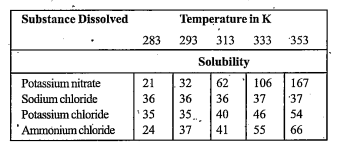
Pragya tested the solubility of three different substances at different temperatures - and collected the data as given below (results are given in thefollowing table, as grams of substance dissolved in 100 grams of water to form a saturated solution).

What mass of potassium nitrate would be needed to produce a saturated solution of potassium nitrate to 50 grams of water at 313K?

Promotional Banner

Similar Questions

Explore conceptually related problems

Pragya tested the solubility of three different substances at different temperatures - and collected the data as given below (results are given in thefollowing table, as grams of substance dissolved in 100 grams of water to form a saturated solution). What is the effect of change of temperature on the solubility of a salt?

Pragya tested the solubility of three different substances at different temperatures - and collected the data as given below (results are given in thefollowing table, as grams of substance dissolved in 100 grams of water to form a saturated solution). Find the solubility of each salt at 293K. Which salt has the highest solubility at this temperature?

Pragya tested the solubility of three different substances at different temperatures - and collected the data as given below (results are given in thefollowing table, as grams of substance dissolved in 100 grams of water to form a saturated solution). Pragya makes a saturated solution of potassium chloride in water at 353 K and leaves the solution to cool at room temperature. What would she observe as the solution cools? Explain.

Ethylene glycol (molar mass = 62gmol^-1) is a common automobile antifreeze. Calculate the freezing point of a solution containing 12.4g of this substance in 100g of water. Would it be advisable to keep this susbtance in the car radiators during summer? Given K_f for water = 1.86 K kg//mol K_b for water = 0.612 K kg//mol