

Home
Class 12
PHYSICS
A neutral spherical copper particle has ...

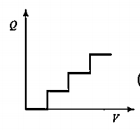
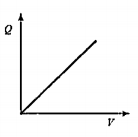
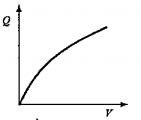
A neutral spherical copper particle has a radius of 10 nm (`1 nm=10^-9m`). It gets charged by applying the voltages slowly adding one electron at a time. Then the graph of the total charge on the particle vs the applied voltage would look like:

A


B


C


D


Text Solution

AI Generated Solution

Promotional Banner

Topper's Solved these Questions

  • SOLVED PAPER 2018

    KVPY PREVIOUS YEAR|Exercise EXAMPLE|24 Videos

Similar Questions

Explore conceptually related problems

A spherical oil drop, radius 10^(-4) cm has on it at a certain a total charge of 40 electrons. Calculate the energy that would be required to place an additional electron on the drop.

If 10^(9) electrons move out of a body to another body every second, then the time required to get a total charge of 1 C on the other body is

A particle moves in a circle of radius 1.0 cm under the action of a magnetic field of 0.40 T .An electric field of 200 V//m makes the path straight.Find the charge/mass ratio of the particle.

A point charge produces an electric flux of -1xx10^(3)Nm^(2)//C to pass through a spherical gaussian surface of radius 10 cm cenred on the charge. What is the value of the point charge?

A thin fixed of radius 1 metre has a positive charge 1xx10^-5 coulomb uniformly distributed over it. A particle of mass 0.9 gm and having a negative charge of 1xx10^-6 coulomb is placed on the axis at a distance of 1cm from the centre of the ring. Show that the motion of the negatively charged particle is approaximately simple harmonic. Calculate the time period of oscillations.

If a body gives out 10^(9) electrons every second, how much time required to get a total charge of 1 C from it ?

If 10^18 electrons are taken out every second from a body, then how much time is required to get a total charge of 0.1 C from it?

A particle having a charge of 1.6 x 10^(-19) C enters midway between the two plates of a parallel plate capacitor. The initial velocity of particle is parallel to the plates. A potential difference of300 Vis applied between the two plates. lfthe length of the plates is 10 cm and they are separated by 2 cm, calculate the greatest initial velocity for which the particle will not be able to come out of the plates. The mass of the particle is 12 xx 10^(-24) kg [10^(4) m//s]

KVPY PREVIOUS YEAR-SOLVED PAPER 2019-EXAMPLE
  1. As shown in the schematic below, a rod of uniform cross-sectional area...

    Text Solution

    |

  2. A photon falls through a height of 1 km through the earth's gravitatio...

    Text Solution

    |

  3. 0.02 moles of an ideal diatomic gas with initial temperature 20^@C is ...

    Text Solution

    |

  4. A heater supplying constant power P watts is switched on at time t=0 m...

    Text Solution

    |

  5. Unpolarized red light is incident on the surface of a lake at incident...

    Text Solution

    |

  6. A neutral spherical copper particle has a radius of 10 nm (1 nm=10^-9m...

    Text Solution

    |

  7. A charge +q is distributed over a thin ring of radius r with line char...

    Text Solution

    |

  8. Originally the radioactive beta decay was thought as a decay of a nucl...

    Text Solution

    |

  9. One gram-mole of an ideal gas A with the ratio of constant pressure an...

    Text Solution

    |

  10. How will the voltage (V) between the two plates of a parallel plate ca...

    Text Solution

    |

  11. Three large identical plates are kept close and parallel to each other...

    Text Solution

    |

  12. A metal rod of cross-sectional area 10^(-4)m^2 is hanging in a chamber...

    Text Solution

    |

  13. A short solenoid (length l and radius r, with n turns per unit length)...

    Text Solution

    |

  14. Consider the wall of a dam to be straight with height H and length L. ...

    Text Solution

    |

  15. Two containers C1 and C2 of volumes V and 4V respevtively hold the sam...

    Text Solution

    |

  16. Four electrons, each of mass me are in a one dimensional box of size L...

    Text Solution

    |

  17. A rope of length L and uniform linear density is hanging from the ceil...

    Text Solution

    |

  18. A circuit consisits of a coil with inductance L and an uncharged capac...

    Text Solution

    |

  19. The circuit below is used to heat water kept in a bucket. Assuming ...

    Text Solution

    |

  20. A bubble of radius R in water of density rho is expanding uniformly at...

    Text Solution

    |