Home
Class 12
CHEMISTRY
The plot of total vapour pressure as a f...

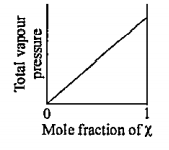
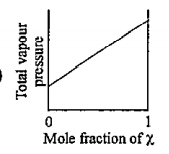
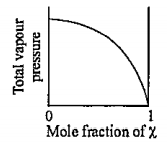
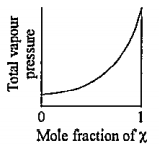
The plot of total vapour pressure as a function of mole fraction of the component of an ideal solution formed by mixing liquids X and Y is

A


B


C


D


Text Solution

Verified by Experts

Promotional Banner

Topper's Solved these Questions

  • QUESTION PAPER 2020

    KVPY PREVIOUS YEAR|Exercise PART-II(CHEMISTRY)|10 Videos
  • SOLVED PAPER 2019

    KVPY PREVIOUS YEAR|Exercise EXAMPLE|30 Videos

Similar Questions

Explore conceptually related problems

Vapor pressure of a solution of Volatile components and composition of vapor: Consider a solution containing 738 g of water and 253 g of ethanol (C_(2)H_(5)OH) at 323 K . At this temperature, the vapour pressure of pure ethanol is 0.292 atm and the vapor pressure of pure water is 0.122 atm . Calculate the vapour pressure of the solution and mole fraction of every component in vapour phase. Strategy: First calculate the moles and the mole fraction of each component in the liquid solution. Then apply Raoult's law to each of the two volatile components to calculate their partial pressures. The total vapour pressure is the sum of the partial vapour pressures of the components and the mole fraction of a components in a gaseous mixture equals the ratio of its partial pressure to the total pressure.

Two liquid A and B form an ideal solution at temperature T. When the total vapout pressure above the solution is 400 torr , the mole fraction of A in the vapour phase is 0.40 and in the liquid phase 0.75. What are the vapour pressure of pure A and pure B at temperature T?

When a liquid is completely miscible with another liquid, a homogeneous solution consisting of a single phase is formed. If such a solution is placed in a closed evacuated vessel, the total pressure exerted by the vapour, after the system attained equilibrium will be equal to the sum of partial pressures of the constituents. A solution is said to be ideal if its constituents follow Raoult's law under all conditions of concentrations, i.e., where p_(i) is the partial pressures of the constituent i, whose mole fraction in the solution is x_(i) and p_(i)^(@) is the corresponding vapour pressure of the pure constituent. The change in the thermodynamic functions when an ideal solution is formed by mixing pure components is given by the following expression. Delta_(mix) = G = n_("total") RT sum_(i) x_(i) In x_(i) ...(i) where, n_("total") is the total amount of all the constituents present in the solution. Delta_(mix)F =- n_("total") R sum_(i) x_(i) In x_(i) ......(ii) Delta_(mix)H =- n_("total") RT sum_(i) x_(i) In x_(i) - n_("total") R sum_(i) x_(i) In x_(i) = 0 ........(iii) Delta_(mix) U = 0 .........(iv) Since botli the components of an ideal binary system follow Raoult's law of the entire range of the compositions, the partial pressure exerted by the vapours of these constituents over the solution will be given by p_(A) = x_(A) p_(A)^(@) ..........(v) p_(B) = x_(B) p_(B)^(@) .........(vi) where, x_(A) and x_(B) are the mole fractions of the two constituents in the liquid phase and p_(A)^(@) and p_(B)^(@) are the respective vapour pressure of the pure constituents. The total pressure (p) over the solution will be the sum of the partial pressure. The composition of the vapour phase (y_(A)) can be determined with the help of Dalton's law of partial pressures. Two liquids A and B form an ideal solution at temperature T. when the total vapour pressure above the solution is 600 torr, the mole fraction of A in the vapour phase is 0.35 and in the liquid phase 0.70. The vapour pressure of pure B and A are:

When a liquid is completely miscible with another liquid, a homogeneous solution consisting of a single phase is formed. If such a solution is placed in a closed evacuated vessel, the total pressure exerted by the vapour, after the system attained equilibrium will be equal to the sum of partial pressures of the constituents. A solution is said to be ideal if its constituents follow Raoult's law under all conditions of concentrations, i.e., where p_(i) is the partial pressures of the constituent i, whose mole fraction in the solution is x_(i) and p_(i)^(@) is the corresponding vapour pressure of the pure constituent. The change in the thermodynamic functions when an ideal solution is formed by mixing pure components is given by the following expression. Delta_(mix) = G = n_("total") RT sum_(i) x_(i) In x_(i) ...(i) where, n_("total") is the total amount of all the constituents present in the solution. Delta_(mix)F =- n_("total") R sum_(i) x_(i) In x_(i) ......(ii) Delta_(mix)H =- n_("total") RT sum_(i) x_(i) In x_(i) - n_("total") R sum_(i) x_(i) In x_(i) = 0 ........(iii) Delta_(mix) U = 0 .........(iv) Since botli the components of an ideal binary system follow Raoult's law of the entire range of the compositions, the partial pressure exerted by the vapours of these constituents over the solution will be given by p_(A) = x_(A) p_(A)^(@) ..........(v) p_(B) = x_(B) p_(B)^(@) .........(vi) where, x_(A) and x_(B) are the mole fractions of the two constituents in the liquid phase and p_(A)^(@) and p_(B)^(@) are the respective vapour pressure of the pure constituents. The total pressure (p) over the solution will be the sum of the partial pressure. The composition of the vapour phase (y_(A)) can be determined with the help of Dalton's law of partial pressures. For an ideal solution in which p_(A)^(@) gt p_(B)^(@) , the plot of total pressure (p) us the mole fraction of A at constant temperature in the vapour phase is:

The vapour pressure of pure benzene and toluene at 40^(@)C are 184.0 torr and 59.0 torr, respectively. Calculate the partial presure of benzene and toluene, the total vapour pressure of the solution and the mole fraction of benzene in the vapour above the solution that has 0.40 mole fraction of benzene. Assume that the solution is ideal.

When a liquid is completely miscible with another liquid, a homogeneous solution consisting of a single phase is formed. If such a solution is placed in a closed evacuated vessel, the total pressure exerted by the vapour, after the system attained equilibrium will be equal to the sum of partial pressures of the constituents. A solution is said to be ideal if its constituents follow Raoult's law under all conditions of concentrations, i.e., where p_(i) is the partial pressures of the constituent i, whose mole fraction in the solution is x_(i) and p_(i)^(@) is the corresponding vapour pressure of the pure constituent. The change in the thermodynamic functions when an ideal solution is formed by mixing pure components is given by the following expression. Delta_(mix) = G = n_("total") RT sum_(i) x_(i) In x_(i) ...(i) where, n_("total") is the total amount of all the constituents present in the solution. Delta_(mix)F =- n_("total") R sum_(i) x_(i) In x_(i) ......(ii) Delta_(mix)H =- n_("total") RT sum_(i) x_(i) In x_(i) - n_("total") R sum_(i) x_(i) In x_(i) = 0 ........(iii) Delta_(mix) U = 0 .........(iv) Since botli the components of an ideal binary system follow Raoult's law of the entire range of the compositions, the partial pressure exerted by the vapours of these constituents over the solution will be given by p_(A) = x_(A) p_(A)^(@) ..........(v) p_(B) = x_(B) p_(B)^(@) .........(vi) where, x_(A) and x_(B) are the mole fractions of the two constituents in the liquid phase and p_(A)^(@) and p_(B)^(@) are the respective vapour pressure of the pure constituents. The total pressure (p) over the solution will be the sum of the partial pressure. The composition of the vapour phase (y_(A)) can be determined with the help of Dalton's law of partial pressures. A plot of reciprocal of total pressure ((1)/(p)) (y-axis) us y_(A) (x-axis) gives :

KVPY PREVIOUS YEAR-SOLVED PAPER 2018-EXAMPLE
  1. The complex that can exhibit linkage isomerism is

    Text Solution

    |

  2. The tendency of X in BX(3)(X=F,Cl,Ome, Nme) to form a pi bond with bor...

    Text Solution

    |

  3. Consider the following statement about Langmuir isotherm : (i) The f...

    Text Solution

    |

  4. Among the following , the plot that correctly represents the conductom...

    Text Solution

    |

  5. The correct representation of wavelength intensity relationship of an ...

    Text Solution

    |

  6. The pressure (P)- volume (V)isotherm of a van der Waals gas, at the te...

    Text Solution

    |

  7. Give examples of two buffer solutions prepared by mixing two salt solu...

    Text Solution

    |

  8. The plot of total vapour pressure as a function of mole fraction of th...

    Text Solution

    |

  9. On complete hydrogenation, natural rubber produces

    Text Solution

    |

  10. The average energy of each hydrogen bond in A-T pair is x kcal mol^(-1...

    Text Solution

    |

  11. For the electrochemical cell shown below Pt|H2(p=1atm)|H^+(aq.,xM)||Cu...

    Text Solution

    |

  12. Consider the following reversible first - order reaction of X at an in...

    Text Solution

    |

  13. Nitroglycerine (MW =227.1) detonates according to the following equat...

    Text Solution

    |

  14. The heating of (NH(4))2Cr(2)O(7) produces another chromium compound al...

    Text Solution

    |

  15. The complex having the highest spin-only magnetic moment is

    Text Solution

    |

  16. Among Ce(4f^(1)5d^(1)6s^(2)), Nd(4f^(4)6s^(2)),Eu(4f^(7)6s^(2))" and "...

    Text Solution

    |

  17. The major product of the following reaction sequence,

    Text Solution

    |

  18. Among the following reactions ,a mixture of diastereomers is produced ...

    Text Solution

    |

  19. Reaction of phenol with NaOH followed by heating with CO(2) under high...

    Text Solution

    |

  20. Tetrapeptide is made of naturally occuring alanine , serine glycine an...

    Text Solution

    |
