

Home
Class 12
PHYSICS
Two equal masses are situated at a separ...

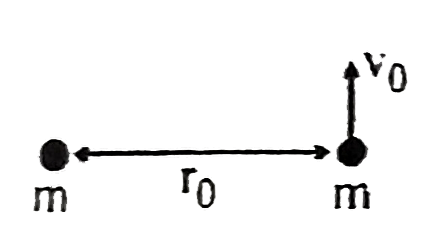
Two equal masses are situated at a separation `r_(0)` One of them is imparted a velocity `v_(0)=sqrt((GM)/r_(0))` perpendicular to the line joining them both are free to move Treating motion only under mutual gravitational force find the ratio of maximum and minimum separation between them. [Hint Solve in CM frame]

Promotional Banner

Similar Questions

Explore conceptually related problems

Two particles of masses 1 kg and 2 kg are placed at a separation of 50 cm find out gravitational force between them

Two bodies of mass m_(1) and m_(2) are initially at rest placed infinite distance apart. They are then allowed to move towards each other under mutual gravitational attaction. Show that their relative velocity of approach at separation r betweeen them is v=sqrt(2G(m_(1)+m_(2)))/(r)

Two protons parallel to each other, keeping distane r between them, both moving with same velocity vecV Then the ratio of the electric is magnetic force of interaction between them is .

Two particles of equal mass m_(0) are moving round a circle of radius r due to their mutual gravitational interaction. Find the time period of each particle.

Three particles, each of mass m, are situated at the situated at the vertices of an equilateral triangle of side 'a'. The only forces acting on the particles are their mutual gravitational forces. It is intended that each particle moves along a circle while maintaining their original separation 'a'. Determine the initial velocity that should be given to each particle and the time period of the circular motion. The resultant force on particle at A due to other two particles is

Two particles of masses 'm' and '9m' are separated by a distance 'r'. At a point on the line joining them the gravitational field is zero. The gravitational potential at that point is (G = Universal constant of gravitation)

Three particles, each of the mass m are situated at the vertices of an equilateral triangle of side a . The only forces acting on the particles are their mutual gravitational forces. It is desired that each particle moves in a circle while maintaining the original mutual separation a . Find the initial velocity that should be given to each particle and also the time period of the circular motion. (F=(Gm_(1)m_(2))/(r^(2)))

Two small bodies of masses 10 kg and 20 kg are kept a distnce 1.0 m apart and released. Assuming that only mutual gravitational force are acting, find the speeds of te particles when the separation decreases to 0.5 m.

Three parties, each of mass m, are situated at the vertices of an equilateral triangle of side length a . The only forces acting on the pariclaes are th eir mutual gravitational forces. It is desired that each particles moves ina a circle while maintaining the original mutual separation a. Find the initial velocity that should be given to each particle and also the time period of teh circular motion.