

Home
Class 12
PHYSICS
An insulating cylinder contains equal vo...

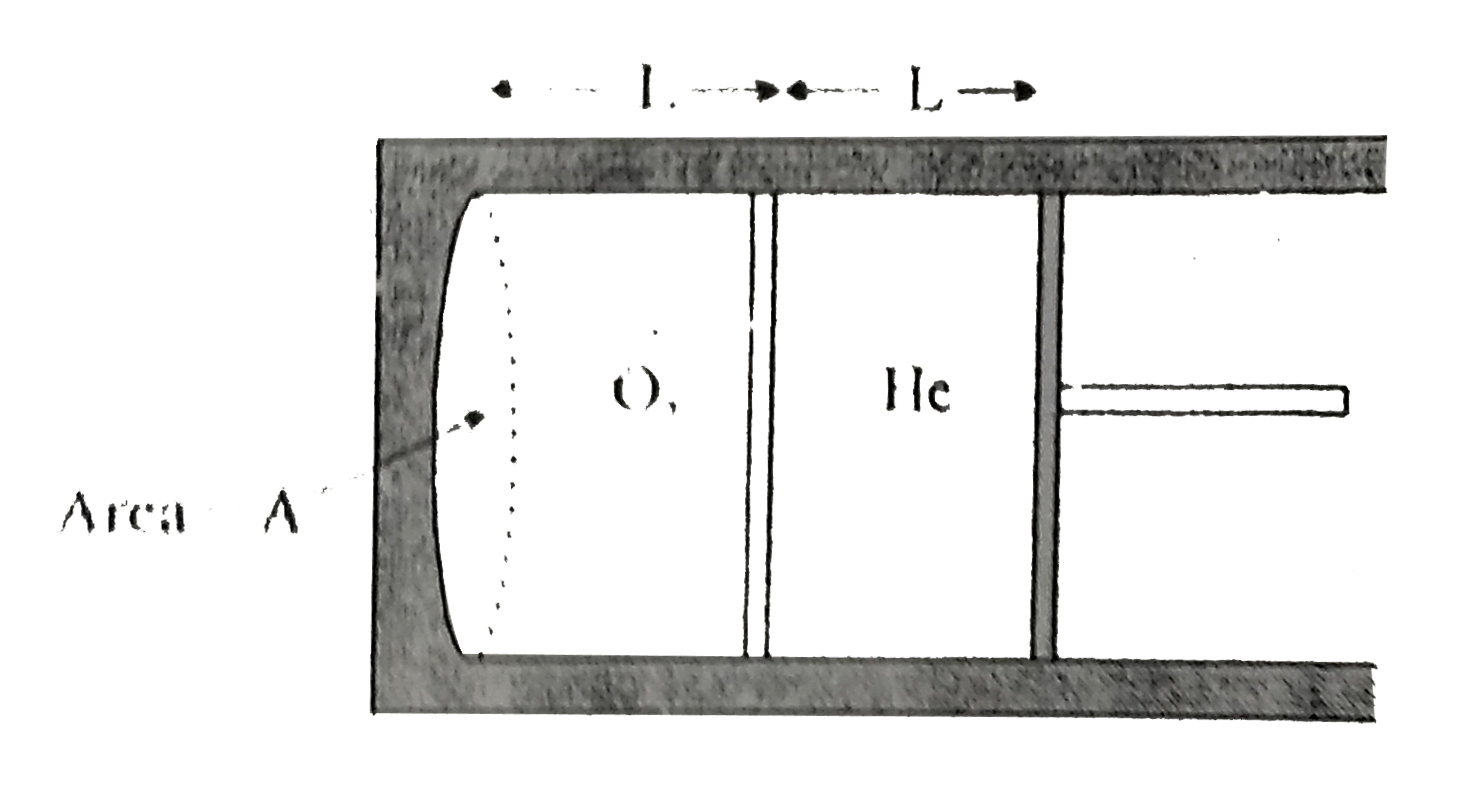
An insulating cylinder contains equal volumes of He and `O_(2)` separated by a massless freely moving adiabatic piston as shown. The gas is compressed by moving the insulating piston so that volume of He becomes half. Select the correct alternative(s).

Promotional Banner

Similar Questions

Explore conceptually related problems

A cylinder contains equal volumes of Ar and H_(2) , separated by a freely movable piston B. Piston A can also move without friction. Volume of each gas in equilibrium is V_(0) . All walls of the container including piston A are non conducting. (i) Piston A is pushed down slowly till the volume occupied by argon becomes (V_(0))/(4) . Find the volume of H_(2) . Assume that piston B is also non conducting. (ii) Now assume that piston B is conducting and assume that each gas has n moles. The external agent performs work W_(0) in slowly pushing down the piston A. Find rise in temperature of each gas.

A perfect gas in a cylinder provided with frictionless piston is at 37^(@)C . The gas is cooled at constant pressure so that its volume becomes (4//5)th of its initial volume. Find the resulting temperature.

(i) A conducting piston divides a closed thermally insulated cylinder into two equal parts. The piston can slide inside the cylinder without friction. The two parts of the cylinder contain equal number of moles of an ideal gas at temperature T_(0) . An external agent slowly moves the piston so as to increase the volume of one part and decrease that of the other. Write the gas temperature as a function of ratio (beta) of the volumes of the larger and the smaller parts. The adiabatic exponent of the gas is gamma . (ii) In a closed container of volume V there is a mixture of oxygen and helium gases. The total mass of gas in the container is m gram. When Q amount of heat is added to the gas mixture its temperature rises by Delta T . Calculate change in pressure of the gas.

Suppose there are N molecules each of mass m, of an ideal gas in a container. The x component of velocity of a molecule is denoted by u_(x) . The gas is enclosed using a horizontal piston of area A as shown. If the piston is moved so as to reduce the volume of gas by half, keeping the temperature of gas constant , we know from the gas law that the pressure will be doubled. On microscopic level the increase in pressure on the piston is because

A cylindrical vessel made of thermally insulating material is divided into two equal parts by an insulating and. Movable piston. Both parts contain ideal monoatomic gas . The gas in the left part is supplied heat such that the volume of right part becomes one-eight of its initial volume . Work done by the gas in the right part is

An horizontal insulated cylindrical vessel of length 2l is separated by a thin insulating piston into two equal parts as shown. Each part contains n moles of an ideal monoatomic gas at temperature T. The piston is connected to end faces of cylinder with help of two springs each of spring constank k. Initially both springs are in relaxed state. The temperature of left part of cylinder is kept constant by some external means while heat is supplied to right part with help of filament. Answer following questions. If energy Q is supplied to right part so that the piston moves to left by l/4 then change in internal energy of right part of cylinder is

(i) An adiabatic cylinder contains an ideal gas. It is fitted with a freely movable insulating piston. In one experiment the piston is pulled out very fast to double the volume of the gas. In another experiment starting from same initial state, the piston is pulled out very slowly to double the volume of the gas. At the end of which experiment the final pressure of the gas will be higher? (ii) An ideal gas is contained in a cylinder fitted with a movable piston. In an experiment ‘A’ the gas is allowed to perform a work W (gt 0) on the surrounding during an isobaric process and thereafter the pressure of the gas is reduced isochorically to half the initial value. At the end of the experiment the temperature of the gas is T_(A) . In a different experiment ‘B’ the pressure of the gas is reduced to half in an isochoric process and then the gas performs a work W on the surrounding during an isobaric process. At the end of the experiment the gas temperature is T_(B) . Which is higher, T_(A) or T_(B) ?

A heat insulating cylinder with a movable piston contins 5 moles of hydrogen at standard temperature and prssure if the gas is cmpressed to quarter of its original volume then the pressure of the gas is increased by (gamma=1.4)

A closed hollow insulated cylinder is filled with gas at 0^(@)C and also contains an insulated piston of negligible weight and negligible thickness at the middle point. The gas on one side of the piston is heated to 100^(@)C . If the piston moves 5 cm the length of the hollow cylinder is