

Home
Class 11
PHYSICS
A belt moves over two pulleys A and B as...

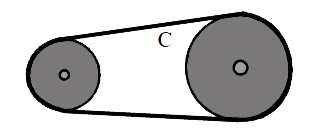
A belt moves over two pulleys A and B as shown in the figure. The pulleys are mounted on two fixed horizontal axles. Radii of the pulleys A and B are 50 cm and 80 cm respectively. Pulley A is driven at constant angular acceleration of 0.8 `"rad/s"^2` unitl pulley B acquries an angular velocity of 10 rad/s. The belt does not slide on either of the pulleys.

(a)Find the acceleration of a point C on the belt and angular acceleration of the pulley B.
(b) How long does it take for the pulley B to acquire an angular velocity of 10 rad/s ?

Promotional Banner

Similar Questions

Explore conceptually related problems

Angular acceleration of the cylinder C shows in the figure is (all strings and the pulley are ideal)

Acceleration of pulleys and blocks are as shown in the figure. All pulleys & strings are massless & frictionless magnitude of a_(A) and a_(B) are : .

In the figure, the blocks unequal masses m_1 and m_2 ( m_1 lt m_2 ). m_2 has a downward acceleration a. The pulley P has a radius r, and some mass. The string does not slip on the pulley. Find the acceleration of block and angular acceleration of pulley. (I = momentum of inerita of pulley)

A thread is wound around two discs on either sides. The pulley and the two discs have the same mass and radius. There is no slipping at the pulley and no friction at the hinge. Find out the acceleration of the two discs and the angular acceleration of the pulley.

In the arrangement shown, the pulleys and the string are ideal. The acceleration of block B is.

In the arrangement shown, the pulleys and the strings are ideal.The acceleration of the block B is

All pulleys are massless The string is light and inextensible Find acceleration of centre of pulley 'p' in m//s^(2)

In the arrangement shown, the pulleys and strings are massless. The acceleration of block B is :