

Home
Class 11
PHYSICS
A charged particle q is shot from a larg...

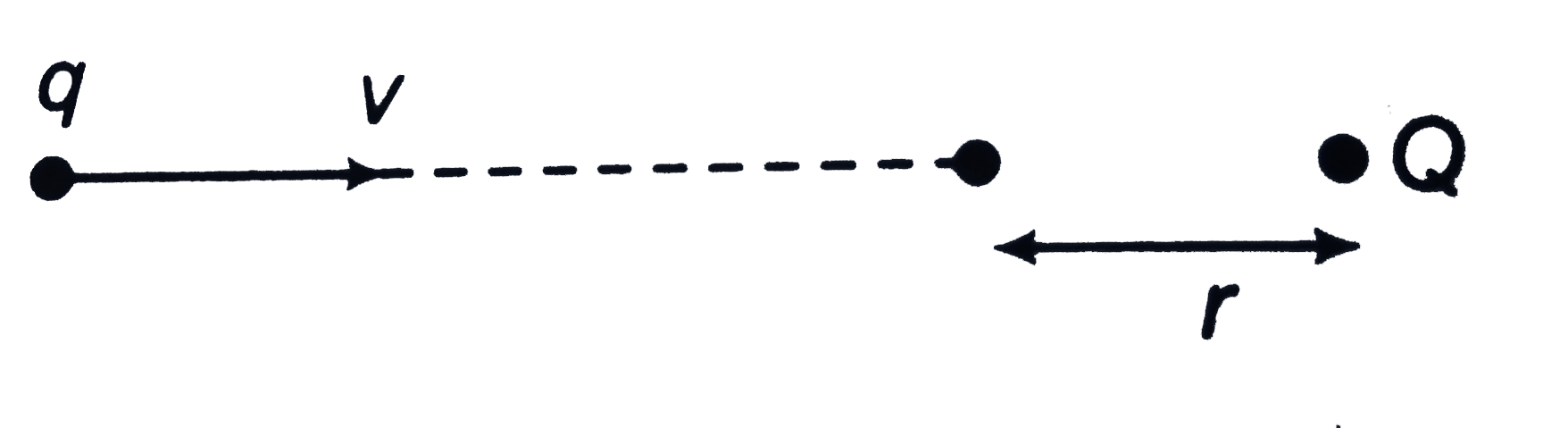
A charged particle q is shot from a large distance towards another charged particle Q which is fixed, with speed v. It approaches Q up to as closed distance r and then returns. If q were given a speed 2v, the distance of approach would be

Promotional Banner

Similar Questions

Explore conceptually related problems

A charged particle q is shot from a large distance twoards another charged particle Q which is fixed, with speed v. It approaches Q up to as closed distance r and then returns. If q were given a speed 2v, the distasnce of approach would be

A charge particle 'q' is shot towards another charged particle 'Q' which is fixed, with a speed 'v'. It approaches 'Q' upto a closest distance r and then returns. If q were given a speed of '2v' the closest distances of approach would be

Figure shows a charge +Q clamped at a point in free space. From a large distance another charge particle of charge -q an.d mass m is thrown toward +Q with an impact parameter d as shown with speed v. Find the distance of closest approach of the two particles.

A charge q of mass m is projected form a long distance with speed v towards another stationery particle of same mass and charge the distance of closet approach of the particles is

A charge particle q_(1) , is at position (2, -1, 3). The electrostatic force on another charged particle q_(2) at (0, 0, 0) is :

A charged particle of mass m and charge q is kept initially at rest on a frictionless surface. Another charged particle of mass 4m and charge 2q starts moving with velocity v towards it. Calculate the distance of the closest approach for both the charged particles.

A particle of mass m, charge q gt 0 and initial kinetic energy K is projected from infinity towards a heavy nucleus of charge Q assumed to have a fixed position. (a) If the aim is perfect, how close to the centre of the nucleus is the particle when it comes instantaneously to rest ? (b) With a particular imperfect aim, the particle's closest approach to nucleus is twicw the distance determined in (a). Determine speed of particle at the closest distance of approach.

A charged particle of charge 'Q' is held fixed and another charged particle of mass 'm' and charge 'q' (of the same sign) is released from a distance 'r'. The impulse of the force exerted by the external agent on the fixed charge by the time distance between 'Q' and 'q' becomes 2 r is

A charge "Q" of mass "m" is at rest on a smooth horizontal plane.Another identical particle is projected with a velocity v towards it from long distance then