Home
Class 12
CHEMISTRY
Which of the following curves represents...

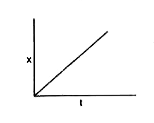
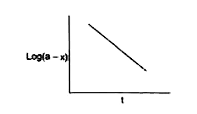
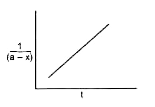
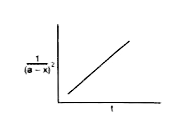
Which of the following curves represents a zero order reaction ? [`(a-x)` =reactant concn.]

A

B

C

D

Text Solution

AI Generated Solution

The correct Answer is:

To determine which curve represents a zero-order reaction, we need to understand the characteristics of zero-order kinetics and how they are represented graphically. ### Step-by-Step Solution: 1. **Understand Zero-Order Reactions**: - In a zero-order reaction, the rate of reaction is constant and does not depend on the concentration of the reactant. This means that the rate of reaction remains the same regardless of how much reactant is present. 2. **Rate Law for Zero-Order Reactions**: - The rate law for a zero-order reaction can be expressed as: \[ \text{Rate} = k \] - Here, \( k \) is the rate constant. 3. **Integrated Rate Equation**: - The integrated rate equation for a zero-order reaction is given by: \[ [A] = [A_0] - kt \] - Where: - \([A]\) is the concentration of the reactant at time \( t \), - \([A_0]\) is the initial concentration of the reactant, - \( k \) is the rate constant, - \( t \) is the time. 4. **Graphical Representation**: - When we plot the concentration of the reactant \([A]\) (or \(A - x\), where \(x\) is the amount of reactant that has reacted) against time \(t\), we get a straight line. - The slope of this line is negative and equal to \(-k\). - The y-intercept of this graph is the initial concentration \([A_0]\). 5. **Identifying the Correct Curve**: - To identify which curve represents a zero-order reaction, look for a straight line with a negative slope when plotting \([A]\) (or \(A - x\)) on the y-axis and time \(t\) on the x-axis. - If the graph is linear and decreases over time, it indicates a zero-order reaction. ### Conclusion: Based on the characteristics and graphical representation of zero-order reactions, the correct curve will be the one that shows a straight line with a negative slope when plotting the concentration of the reactant against time.
Promotional Banner

Topper's Solved these Questions

  • CHEMICAL KINETICS

    RC MUKHERJEE|Exercise PROBLEMS |42 Videos
  • CHEMICAL EQUIVALENCE

    RC MUKHERJEE|Exercise PROBLEMS|24 Videos
  • CHEMICAL THERMODYNAMICS

    RC MUKHERJEE|Exercise Objective problems|58 Videos

Similar Questions

Explore conceptually related problems

Which of the following curves represents a third order reaction ?

Which of the following curves represents a first order reaction.

Which of the following graphs represents a first order reaction ?

Which of the following curves represents a second order reaction ? [x = product oncentration (a-x) = reactant concentration)

Which of the following curve represent zero order reaction of A rarr products ?

Which of the following graph is correct for zero order reaction?

RC MUKHERJEE-CHEMICAL KINETICS-OBJECTIVE PROBLEMS
  1. A first order reaction is carried out with an initial concentration of...

    Text Solution

    |

  2. Which of the following curves represents a third order reaction ?

    Text Solution

    |

  3. Which of the following curves represents a zero order reaction ? [(a-x...

    Text Solution

    |

  4. 75 % of a first order reaction was completed in 32 min . When was 50 %...

    Text Solution

    |

  5. If doubting the initial concentrations of a reactant doubles t(1/2) of...

    Text Solution

    |

  6. For a given reaction the logarithm of the concentration of the reactan...

    Text Solution

    |

  7. The concept of t(1/2) is useful for the reactions of

    Text Solution

    |

  8. The half - life for a given reaction was halved as the initial concent...

    Text Solution

    |

  9. The rate constant fro a second order reaction is 8 xx 10^(-5) M^(-1) "...

    Text Solution

    |

  10. The rate for a first -order reaction is 8 xx10^(-5) M^(-1)min^(-1). Ho...

    Text Solution

    |

  11. What fraction of a reactant remains after 40 min if t(1/2) is 20 min a...

    Text Solution

    |

  12. For a given reaction, the half-life period was found to be directly pr...

    Text Solution

    |

  13. From different sets of data of t(1//2) at diifferent initial concentra...

    Text Solution

    |

  14. A catalyst increases the rate of a chemical reaction by

    Text Solution

    |

  15. The energy of activation of a forward reaction is 50 kcal . The energy...

    Text Solution

    |

  16. The rate constant , the activation energy and the Arhenius parameter o...

    Text Solution

    |

  17. Which of the following statements is wrong about reactions ?

    Text Solution

    |

  18. The temperature coefficient of a reaction is 2 . The rate of this reac...

    Text Solution

    |

  19. The rate constant of a reaction , A to Product , with initial reactant...

    Text Solution

    |

  20. The rate constant of a reaction , A to Product ,with initial reactant...

    Text Solution

    |
