

Home
Class 11
PHYSICS
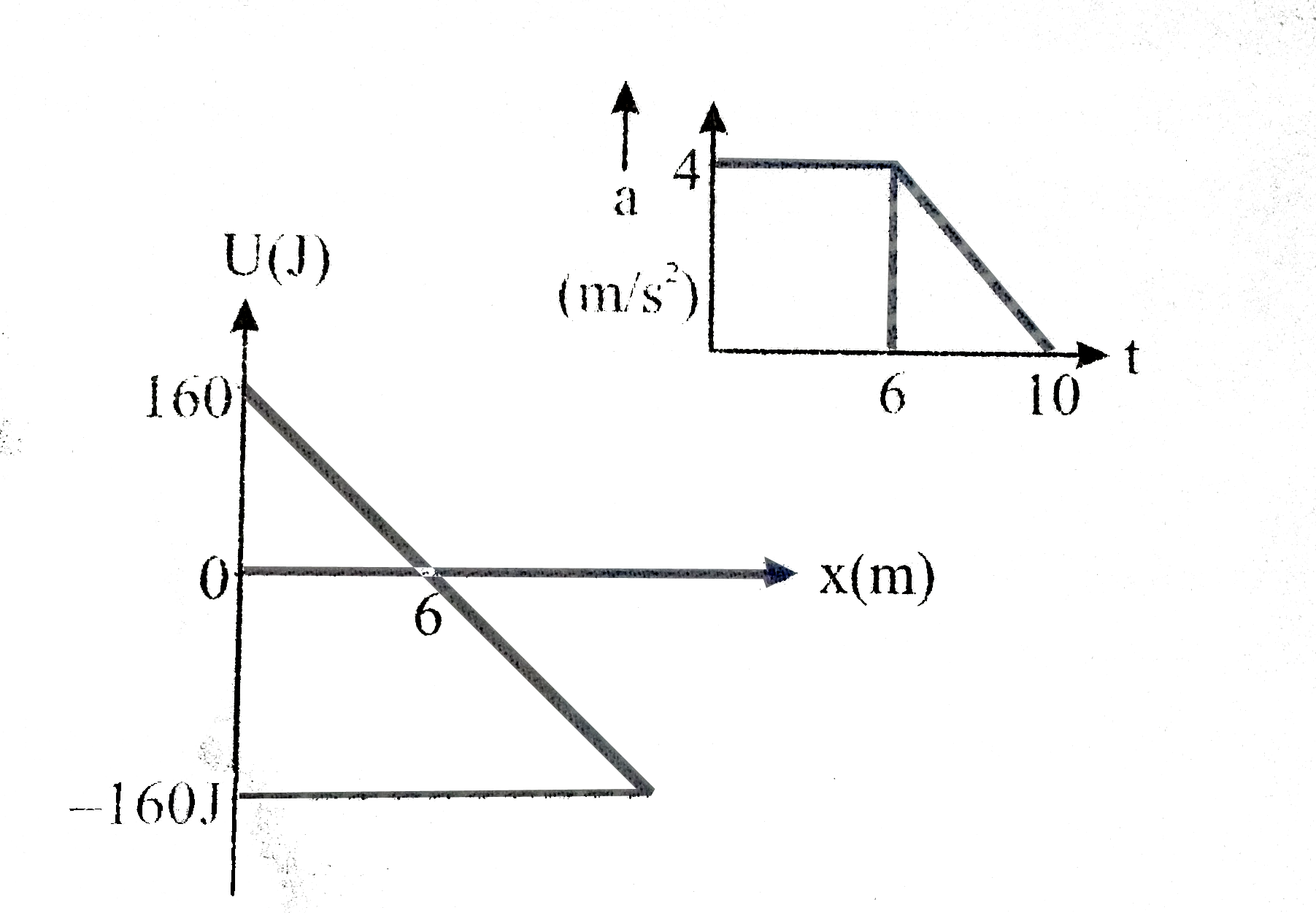
A particle of mass 1 kg is moving X-axis...

A particle of mass `1 kg` is moving X-axis. Its velocity is `6 m//s` at `x = 0`. Acceleration-displacement curve and potential energy-dispalcement curve of the particle are shown :
.

Promotional Banner

Similar Questions

Explore conceptually related problems

If x,F and U denote the dispalcement, force acting on and potential energy of a particle then

A particle of mass 1 kg is moving in straight line and its acceleration v/s displacement graph is shown in figure. Work done by the force during x = 0 to x = 10 m is

A time varying force, F=2t is acting on a particle of mass 2kg moving along x-axis. velocity of the particle is 4m//s along negative x-axis at time t=0 . Find the velocity of the particle at the end of 4s.

A particle of mass m=3 kg is moving on a straight line in a conservative force field in which the potential energy associated with the particle is given by U(y)=2y^(2)-30y+450 . At t=0 , particle is at y=8m and moving towards positive y - axis with 1m//s

The mass of particle is 1 kg it is moving along x- axis The period of its small osciltion is (pi)/(2) . Find the its potential energy:

A particle is moving in a straight line and its velocity varies with its displacement as v=sqrt(4+4s) m/s. Assume s=0 at t=0. find the displacement of the particle in metres at t=1s.

The potential energy of a particle of mass 2 kg moving along the x-axis is given by U(x) = 4x^2 - 2x^3 ( where U is in joules and x is in meters). The kinetic energy of the particle is maximum at

Power of the only force acting on a particle of mass m=1 kg moving in straight line depends on its velocity as P=v^(2) where v is in m/s and P is in watt. If initial velocity of the particle is 1m/s, then the displacement of the particle in ln2 second will be :

The particle moves with rectilinear motion given the acceleration-displacement (a-S) curve is shown in figure, determine the velocity after the particle has traveled 30 m. If the initial velocity is 10m/s

Comprehension # 5 One particle of mass 1 kg is moving along positive x-axis with velocity 3 m//s . Another particle of mass 2 kg is moving along y-axis with 6 m//s . At time t = 0, 1 kg mass is at (3m, 0) and 2 kg at (0, 9m), x - y plane is the horizontal plane. (Surface is smooth for question 1 and rough for question 2 and 3) The centre of mass of the two particles is moving in a straight line which equation is :-